Motorcycle trip packing: 10 Essential, Proven Tips for 2025
The Art of Packing Light: Rider Essentials
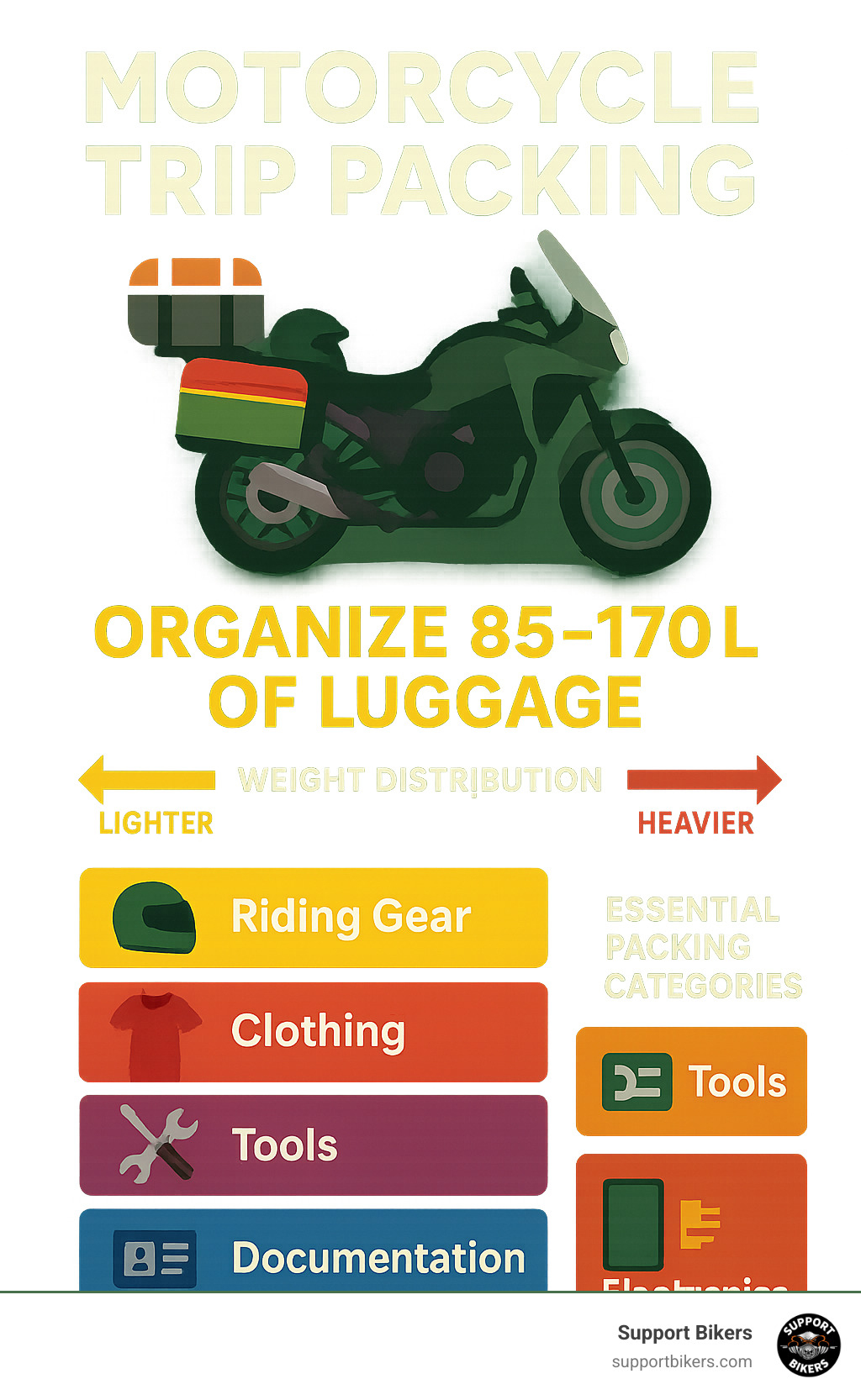
Motorcycle trip packing requires careful planning and smart organization to fit everything you need within limited space. Here’s a quick overview of what you’ll need:
| Category | Essential Items |
|---|---|
| Riding Gear | Helmet, jacket, gloves, boots, rain suit |
| Clothing | 2-3 quick-dry shirts, 2-3 underwear, 1 pair pants |
| Tools | Multi-tool, tire repair kit, zip ties, duct tape |
| Documentation | License, registration, insurance, emergency contacts |
| Electronics | Phone, charger, headset, portable battery |
Packing for a motorcycle trip is all about finding the perfect balance between being prepared and traveling light. With only 85 to 170 liters of storage space on most touring motorcycles, every item must earn its place in your luggage. The key is to pack smart, not heavy.
Unlike car travel, motorcycle trips require you to think carefully about weight distribution, accessibility, and weather protection. Items should be organized by frequency of use, with daily essentials within easy reach and emergency supplies secured but accessible.
The best approach is to lay out everything you think you need, then remove at least 25% before packing.
Most experienced riders recommend bringing only two sets of quick-dry clothing: one to wear and one to pack. This minimalist approach forces you to develop efficient routines like evening hand-washing and morning air-drying.
I’m Sonny Da Badger, and I’ve refined my motorcycle trip packing strategy over decades of riding everything from dirt bikes to Harley CVOs, learning that strategic packing can make the difference between an enjoyable journey and a frustrating one.
Motorcycle trip packing terminology:
– Motorcycle routes USA
– Motorcycle repair shops
– Motorcycle photo shoots
1. Absolute Essentials Every Rider Must Pack
There’s something liberating about hitting the open road with just your motorcycle and the bare necessities. But as any seasoned rider will tell you, “bare necessities” doesn’t mean unprepared.
“I learned the hard way that minimalism is the cornerstone of motorcycle trip packing,” shares Mark Thompson, whose wheels have eaten up over 100,000 miles of North American asphalt. “It’s not about leaving important stuff behind—it’s about carrying only what truly matters.”
After countless miles and conversations with fellow road warriors, I’ve found these items should never be left in your garage when you roll out:
Your helmet and lock aren’t just safety gear—they’re your constant companions. Your vehicle documentation (registration and insurance) might seem boring until you’re pulled over in the middle of nowhere. A compact first-aid kit with bandages, antiseptic, and pain relievers can turn a trip-ending injury into a minor inconvenience. And never underestimate the power of staying hydrated—a 48oz water bottle and portable filter straw can be lifesavers, especially since research shows even mild dehydration dramatically impacts your alertness and reaction time.
Round out your essentials with a quality multi-tool (one with pliers, knife, and various drivers), a spare key secured separately from your primary (I zip-tie mine inside a hidden frame section), about $100 in emergency cash tucked away from your wallet, a simple pocket whistle for emergencies, and your phone with charger loaded with offline maps.
Roadside Documents Pouch
Nothing kills the buzz of a perfect riding day faster than fumbling through your gear looking for paperwork while an officer waits impatiently. Trust me, I’ve been there.
Create a dedicated, waterproof documents pouch that becomes part of your pre-ride checklist. Inside, keep your driver’s license with motorcycle endorsement, vehicle registration, insurance card with policy details, emergency contacts, important medical information (allergies, conditions, medications), and your roadside assistance membership details.
“I keep my documents in two places now,” says long-distance rider Susan Miller, who learned this trick after getting caught in an unexpected downpour. “Originals stay in a waterproof neck wallet under my jacket, and laminated copies live in my tank bag for quick access. No more stripping off rain gear on the roadside!”
Pro tip: Take photos of all your documents, store them in an encrypted, password-protected folder on your phone, and email them to yourself as another backup. This digital safety net has saved countless rides.
Quick-Access Safety Kit
When trouble strikes on the road, you rarely have time to unpack your carefully organized luggage. That’s why every experienced rider keeps critical safety items within immediate reach.
Store your quick-access kit in your tank bag or jacket pocket, including a high-visibility vest (which makes you instantly visible to passing motorists during roadside stops), a mini LED flashlight with fresh batteries, an emergency contact card listing your blood type and allergies, a trauma tourniquet (with the knowledge to use it properly), a small whistle on a breakaway lanyard, some emergency cash, and basic first-aid supplies.
Ryan Cooper, who annually crisscrosses the western states, shared a lesson learned the hard way: “After breaking down in Montana’s backcountry with zero cell service, I swore my emergency kit would always stay within arm’s reach. That high-vis vest alone has been a game-changer when making repairs as daylight fades—it’s like a guide to passing riders who might stop to help.”
The best safety gear is the stuff you can actually reach when you need it—not buried under your camping gear or locked in a pannier.
2. Motorcycle Trip Packing: Choosing the Right Luggage
The foundation of effective motorcycle trip packing is selecting the right luggage system for your bike and journey. Your choices will impact handling, weather protection, security, and convenience.
“Your luggage is like the foundation of a house,” explains veteran tour guide Maria Sanchez. “If that’s not right, nothing else will work properly no matter how well you pack.”
Here’s a comparison of the main luggage options:
| Luggage Type | Pros | Cons | Best For |
|---|---|---|---|
| Hard Panniers | Waterproof, secure, lockable | Heavy, expensive, fixed capacity | Valuable gear, security-conscious riders |
| Soft Saddlebags | Lightweight, adaptable, affordable | Less secure, may require waterproofing | Weekend trips, fair-weather riding |
| Top Case | Easy access, good security, passenger backrest | Affects handling when heavily loaded | Commuting, daily essentials, valuables |
| Duffel/Dry Bag | Versatile, waterproof, removable | Limited organization, requires straps | Camping gear, clothing, supplemental storage |
| Tank Bag | Convenient access while riding, map pocket | Limited capacity, may require tank protection | Maps, snacks, camera, daily essentials |
| Crash Bar Bags | Additional storage, weight distribution | Small capacity, requires crash bars | Tools, spare parts, small heavy items |
I’ve tested dozens of strapping systems over the years, and I have to agree with long-distance rider Staci Wilt who says, “I’ve found ROK Straps to be the ‘bee’s knees’ compared to bungee cords. They’re adjustable, secure, and don’t stretch out over time like bungees.”
Motorcycle Trip Packing for Solo Touring
Solo riders face unique challenges when it comes to luggage. Without a buddy to share the load, you’ll need to be completely self-sufficient while maintaining good bike handling.
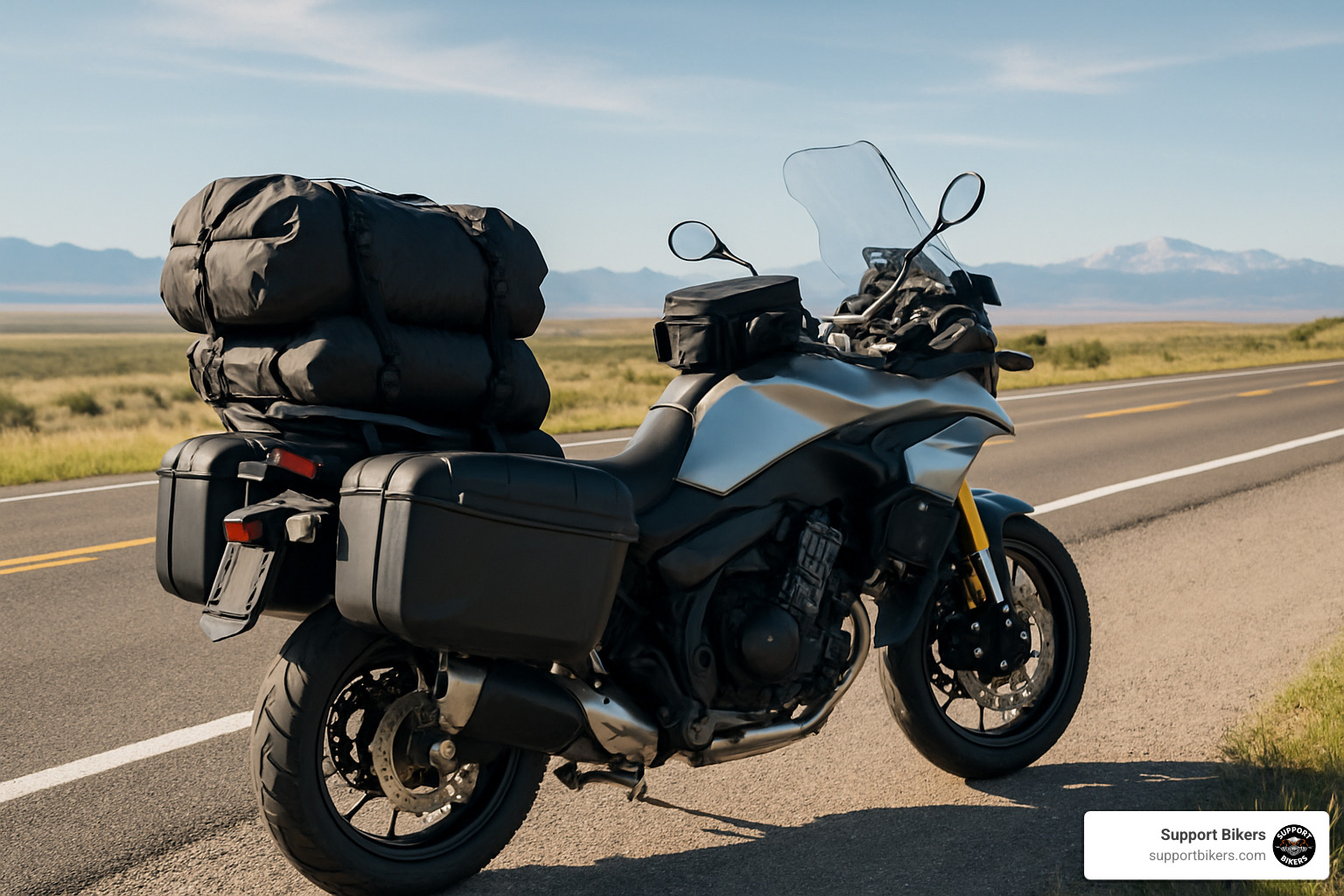
When packing for solo touring, start by knowing your bike’s capacity limits. Check your motorcycle’s manual for maximum weight ratings—exceeding these can turn a fun ride into a dangerous situation, affecting handling and braking in ways you won’t appreciate on a mountain curve.
Maintain center of gravity by keeping heavy items low and centered on the bike. This simple principle makes a world of difference in how your bike handles, especially at highway speeds or in crosswinds.
“On my first cross-country trip, I packed too much and mounted it too high,” admits veteran rider James Wilson. “The bike wobbled at highway speeds and felt unstable in crosswinds. Now I keep heavy items low and centered, and the difference in handling is night and day.”
Use quality mounting systems rather than cheap alternatives. I learned this lesson the hard way when a bargain bungee cord snapped on the highway, nearly causing a serious accident. Invest in proper mounting hardware like ROK straps, purpose-made tie-downs, and dedicated luggage systems—they’re worth every penny.
For convenience, consider quick-release options that can be easily removed and carried. Luggage that transforms into a duffle or backpack makes hotel stops and security much simpler when you need to leave your bike unattended.
Motorcycle Trip Packing Weight Distribution
Proper weight distribution isn’t just a suggestion—it’s critical for maintaining your motorcycle’s handling characteristics and ensuring you’ll actually enjoy those twisty roads instead of fighting your bike through every turn.
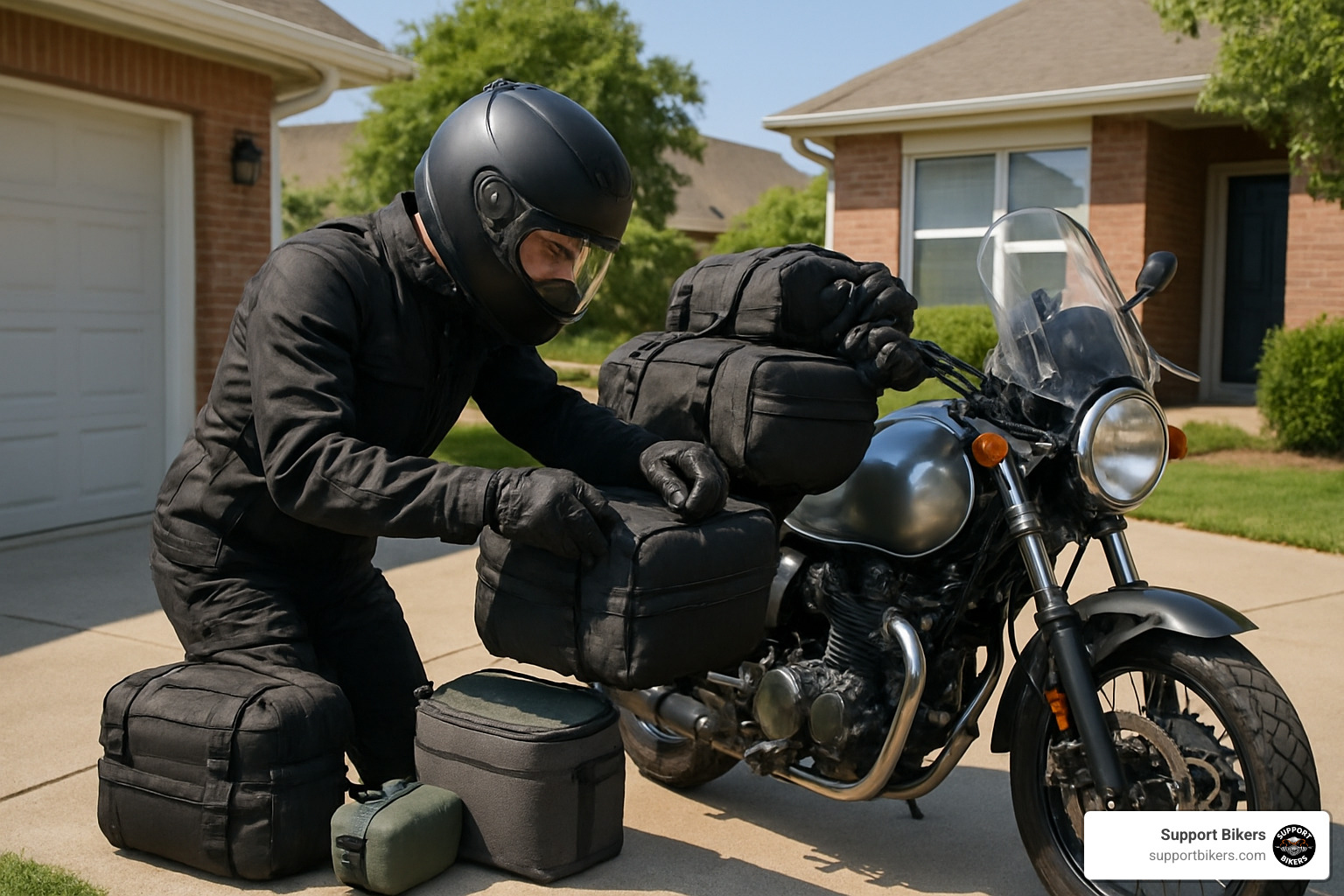
I always pack heavy items low and forward in my luggage setup. Your heaviest gear—tools, spare parts, water—should sit low in the panniers and as close to the bike’s center as possible. This keeps your center of gravity where the engineers intended it to be.
Balance side-to-side weight carefully between your panniers. Even a small imbalance can cause your bike to subtly pull to one side, creating fatigue over long distances. I weigh my panniers on a bathroom scale before departure to ensure they’re within a pound of each other.
“I once made the rookie mistake of putting all my tools in one pannier and clothes in the other,” shares touring enthusiast Maria Rodriguez. “The bike handled terribly until I redistributed the weight evenly. Now I split heavy items between both sides.”
Always leave 10-15% free space in your luggage. This breathing room allows for souvenirs, supplies acquired along the way, and makes repacking much easier after that inevitable roadside repair where everything gets pulled out.
For longer trips or heavy loads, consider adjusting suspension settings. Increasing preload or pressure according to your bike’s specifications can restore proper handling characteristics when fully loaded. Your owner’s manual will have specific recommendations.
Before any major journey, take a test ride with your bike fully loaded. This real-world check will reveal any handling issues, increased braking distance, or clearance problems before you’re committed to a two-week trip.
The TRO pack checklist offers a systematic approach to organizing items by category and weight, ensuring proper distribution for optimal handling. It’s become my go-to resource before any multi-day ride.
3. Smart Packing Techniques: Light, Balanced, Accessible
The magic of motorcycle trip packing isn’t just about what makes the cut—it’s how you organize everything in your limited space. After thousands of miles on the road, I’ve learned that thoughtful organization can make or break your journey.
“I rolled my clothes on my first big trip instead of folding them like I normally would,” shares Sarah Johnson, who’s documented her cross-country rides for over a decade. “I was shocked to find I had about 30% more space in my bags. Now I’d never pack any other way.”
When you’re living out of motorcycle luggage, accessibility becomes just as important as efficiency. There’s nothing worse than unpacking everything at a rainy roadside just to find that elusive rain jacket buried at the bottom.
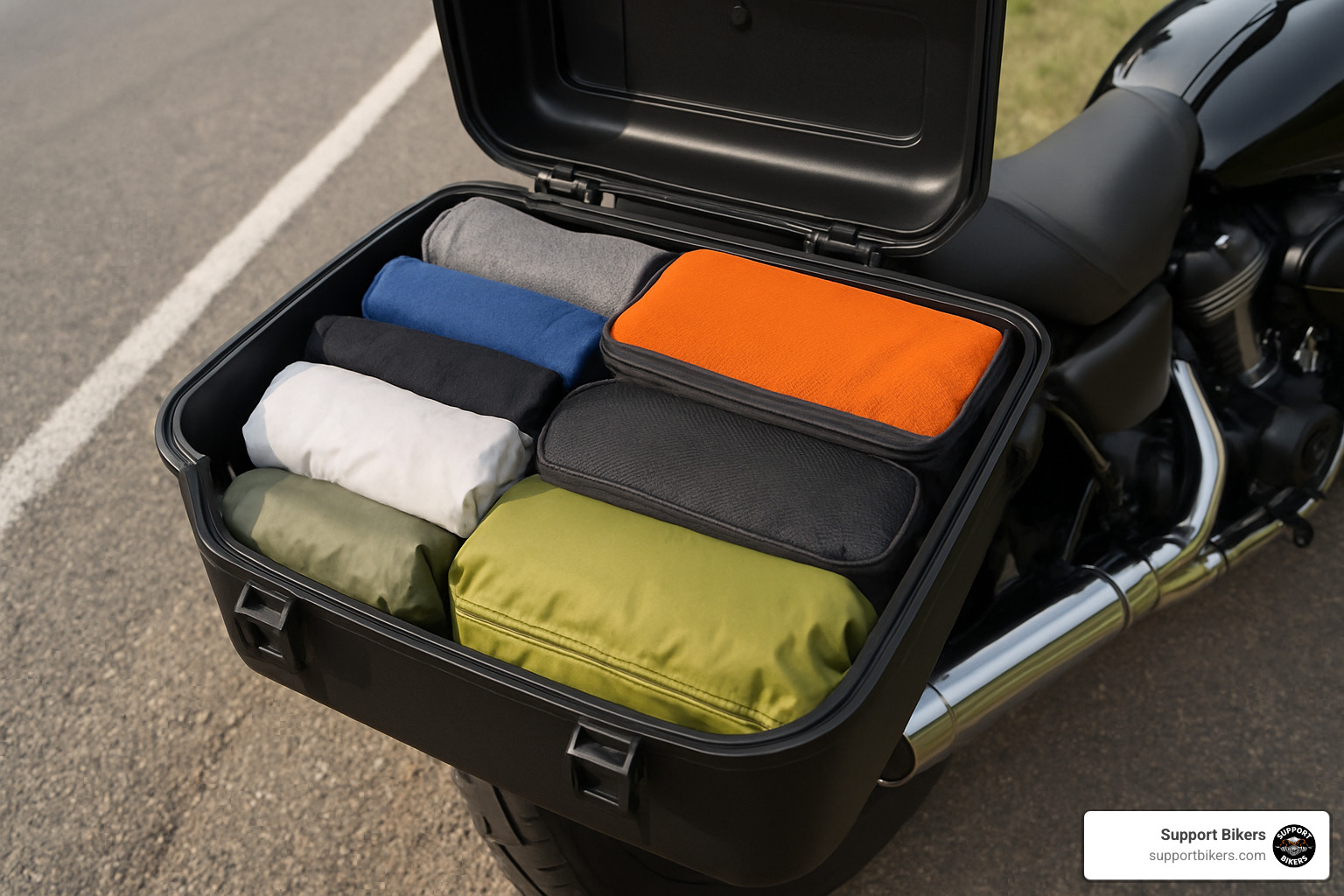
Most seasoned riders develop a layered approach to packing. Items you’ll need frequently (rain gear, snacks, camera) stay accessible in top layers or tank bags, while rarely-needed items (extra tools, spare parts) go at the bottom of panniers.
Rolling clothes creates compact, wrinkle-resistant bundles that nestle perfectly into awkward spaces. Packing cubes take organization to the next level—they not only keep similar items together but compress clothing and maintain order even after days of rummaging. I use color-coded cubes: blue for casual clothes, green for riding layers, and red for electronics.
For bulky items like sleeping bags and down jackets, compression sacks are worth their weight in gold. They can shrink volume by up to 50%, turning that fluffy sleeping bag into something the size of a football.
Many riders swear by color-coded dry bags for foolproof organization. “My system is simple,” explains veteran rider Mike Thompson. “Yellow holds electronics, blue contains clothes, and red is always first-aid. Even in the dark, I know exactly where everything is.”
Before departing, challenge yourself with the leave-behind strategy. After packing everything you think you need, force yourself to remove 10-15% of it. Almost universally, riders report never missing these items and appreciating the extra space.
“I use the ‘wear one, wash one’ approach with quick-dry clothing,” Mike adds. “Two sets of everything is plenty for even month-long trips if you’re willing to rinse things out at night.”
Space-Saving Hacks
Over decades of motorcycle travel, riders have developed clever hacks to maximize every cubic inch of storage.
The Scrubba wash bag has revolutionized long-distance travel. This portable washing “machine” weighs just ounces but lets you properly clean clothes at camp using a built-in washboard pattern. Paired with quick-dry fabrics, it makes the two-set clothing rule practical—pack only two sets of underwear, socks, and base layers, washing one set each evening.
“I’ve found that stuffing socks and small items inside my boots overnight not only saves space but also helps the boots keep their shape,” shares Lisa Chen, who’s logged over 50,000 miles across North America.
Collapsible gear has transformed motorcycle camping. From silicone water bottles that flatten when empty to folding camp chairs and nesting cookware, these innovations save tremendous space. Your riding boots and helmet also offer valuable storage space when not in use—perfect for fragile items or things you’ll need first thing in the morning.
For toiletries, decanting your favorite products into small containers saves significant space compared to carrying full-size bottles. Many riders use contact lens cases for small amounts of creams or ointments.
Group & Pillion Coordination
When traveling with others, smart coordination prevents redundancy and helps distribute weight effectively across multiple bikes.
“My riding buddy and I wasted so much space on our first trip together,” admits Robert Martinez, who’s been touring with his wife for fifteen years. “We had two of everything—two toolkits, two first-aid kits, two tire repair kits. Now we coordinate everything in advance.”
For couples on one bike, weight distribution becomes even more critical. “When my wife and I tour together, we each get one pannier for personal items, and we share the top case for communal gear,” Robert explains. “It forces us to be disciplined about what we bring, and the bike handles much better with balanced weight.”
Establish clear Bluetooth communication protocols before departure. Simple signals like two clicks for “need to stop” or three for “emergency” can make group riding safer and more enjoyable.
When traveling with a passenger, ensure they have access to essentials without dismounting. Items like water bottles, snacks, and cameras should be within reach during breaks, while rarely-used items can be packed deeper in shared luggage.
By applying these smart packing techniques, you’ll not only fit everything you need but also enjoy easier access and better handling throughout your journey—turning good rides into great trips.
4. Weather-Ready Wardrobe & Hygiene
A well-planned wardrobe is essential for comfortable motorcycle trip packing, yet it’s where many riders either overpack or bring the wrong items. The key is preparing for various weather conditions while keeping your luggage light.
“Weather on the road is about as predictable as a cat’s mood after a bath,” laughs veteran rider Emma Thomas. “I’ve ridden through scorching deserts at noon and shivered through mountain passes by sunset—all in the same day.”
Your weather-ready wardrobe doesn’t need to be extensive, just strategic. Start with moisture-wicking base layers that dry quickly—merino wool is worth the investment for its natural temperature regulation and odor resistance. Add a lightweight fleece mid-layer for insulation, and always pack a compact, waterproof rain suit that fits over your riding gear.
Many long-distance riders consider heated gear non-negotiable. “My heated vest transformed winter riding from an endurance test to an enjoyable experience,” shares Colorado-based rider Mark Johnson. “It weighs almost nothing but makes a world of difference when temperatures drop.”
Don’t forget your extremities—pack both summer and insulated gloves, plus a versatile neck gaiter that serves multiple purposes from sun protection to dust filtering to warmth. A microfiber quick-dry towel takes up minimal space but proves invaluable after a roadside shower or unexpected downpour.
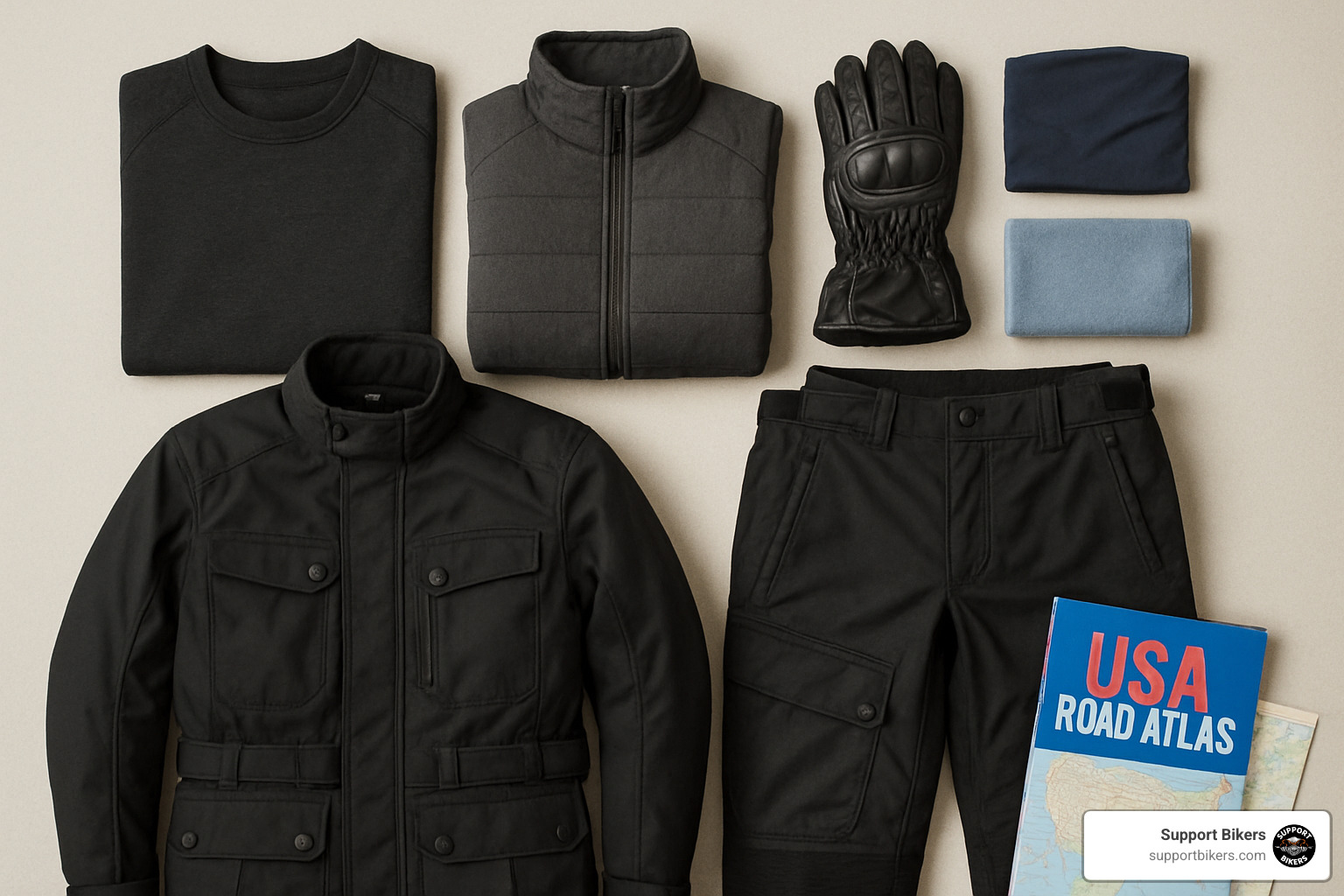
Hot-to-Cold Packing Formula
The secret to handling temperature variations lies in a thoughtful layering system. Start with one or two pairs of merino wool socks—they regulate temperature in both hot and cold conditions and resist odors even after multiple days of wear.
Convertible pants with zip-off legs give you flexibility for changing temperatures without taking up extra space. “They might not win fashion awards,” jokes Thomas Chen, who rode from Death Valley’s 110°F heat to near-freezing Sierra Nevada temperatures in a single day, “but they’re incredibly practical when space is limited.”
A lightweight down jacket serves double duty as both warmth layer and pillow when compressed into its stuff sack. When paired with a waterproof shell, you’re prepared for nearly any weather condition. For extreme cold, a heated liner connects to your motorcycle’s electrical system to keep your core warm.
Female riders have finded some clever packing solutions. “A silk dress is my secret weapon,” shares Staci Wilt, who’s logged over 50,000 miles across North America. “It weighs practically nothing, doesn’t wrinkle, and gives me something non-motorcycle to wear for evenings in town.”
Staying Clean on the Road
Maintaining hygiene during long motorcycle trips requires creativity, but it’s entirely possible to stay fresh with minimal supplies.
Multi-purpose products are your best friends. Dr. Bronner’s soap or Camp Suds can wash your body, hair, and even your clothes. Pack a small bottle and you’re covered for all cleaning needs. A portable clothesline made from simple paracord with a few clothespins lets you wash and dry clothing overnight at campsites.
“Never underestimate the morale boost of clean socks,” emphasizes James Wilson, who regularly takes month-long trips. “I use a weekly pill organizer as a compact toiletry case—each compartment holds just enough soap, shampoo, and toothpaste for daily use, and it’s completely waterproof.”
Flip-flops serve multiple purposes—they protect your feet in questionable showers, give your riding boots a break, and some even come with bottle openers built into the soles. For quick refreshes between proper showers, biodegradable wet wipes and hand sanitizer are invaluable.
Female riders often recommend tinted moisturizers with SPF as space-saving alternatives to separate sunscreen, foundation, and moisturizer. “When you’re living out of panniers, products that serve multiple purposes aren’t just convenient—they’re essential,” notes long-distance rider Maria Lopez.
Dry shampoo has saved many a rider’s appearance on days when full showers aren’t possible. A small travel-sized bottle can extend time between hair washing while keeping you looking and feeling fresher.
Motorcycle trip packing for hygiene isn’t about maintaining your normal routine—it’s about adapting to life on the road while staying comfortable and presentable with minimal supplies.
5. Tools, Electronics & Camp Kitchen: Self-Reliance on the Road
There’s something deeply satisfying about being self-sufficient on a motorcycle journey. When you’re miles from the nearest service station, having the right tools and equipment transforms potential disasters into minor detours.
“Every rider remembers that first time they had a flat in the middle of nowhere,” laughs veteran tourer Jason Martinez. “With the right tools and a bit of know-how, what could be a trip-ender becomes just a colorful story to tell later.”
Your road-readiness kit doesn’t need to be massive, but it should be thoughtful. A compact tool roll, tire repair kit, and mini-compressor form the backbone of your mechanical preparedness. Add some chain lube, zip ties, and electrical tape – the motorcycle equivalent of duct tape – and you’ve covered most roadside emergencies.
For electronics, a jump-start power bank pulls double duty by charging your devices and potentially saving you from a dead battery. A weatherproof phone mount keeps navigation visible, while a Bluetooth comm system keeps you connected to riding partners or your favorite podcasts during those long stretches of highway.
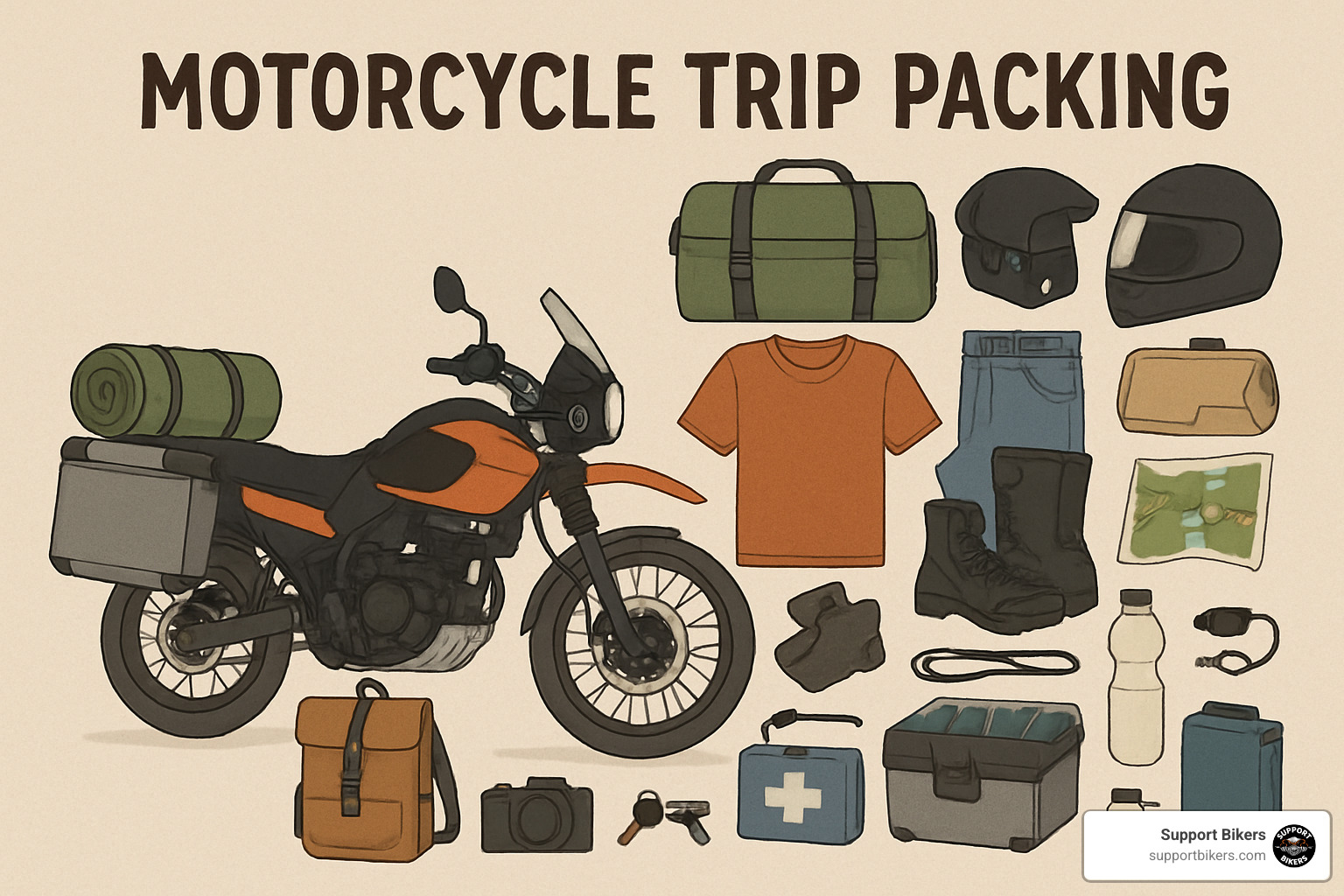
When it comes to camp cooking, simplicity reigns supreme. A Jetboil stove boils water in minutes, turning those dehydrated meals into surprisingly satisfying dinners. Collapsible silicone bowls and a trusty spork make for an ultra-packable kitchen that still delivers comfort at the end of a long riding day.
According to research on tool preparedness, knowing how to use your tools is just as important as having them. “Practice changing a tube in your garage before you have to do it on the side of a mountain in the rain,” advises the study. Wise words indeed.
Minimalist Wrench List
You don’t need your entire garage toolkit, but a few quality pieces will handle most roadside fixes. The ultra-light, ultra-functional kit that seasoned riders swear by includes 8-14mm spanners that cover most motorcycle fasteners, a good hex/Allen key set for fairings and adjustments, and a Snapjack v2 portable jack that makes tire repairs possible anywhere.
“The tools that came with my bike are what we lovingly call ‘butter tools’ – they’ll bend the first time you really need them,” chuckles Eric Stevens, who’s logged over 100,000 miles on his Harley. “Investing in quality compact tools is worth every penny, even if you only need them once a year.”
Wrap some duct tape around a lighter for dual functionality, throw in various sizes of cable ties, and add a quality multitool with pliers for electrical work. Round out your kit with a digital tire pressure gauge for accuracy and the spark plug tool specific to your motorcycle.
Charging & Power Management
In our connected world, keeping devices charged isn’t just about comfort—it’s about safety. A battery-tender USB outlet wired directly to your motorcycle battery provides reliable charging while riding without draining your bike’s power system.
“I’ve learned the hard way that a dead phone in remote areas isn’t just inconvenient—it can be dangerous,” shares Mike Thompson, who regularly traverses the Continental Divide. “My USB pigtail connected to the battery gives me reliable power for GPS without worrying about draining the bike.”
For overnight or extended stops, a large-capacity power bank (20,000+ mAh) keeps multiple devices happy. Add a versatile SAE lighter socket adapter and a charging hub that handles several electronics at once, and you’re set for most situations. For truly remote trips, a compact solar charger can be worth its weight in gold.
Food & Water Routine
Your body is your most important piece of equipment, and keeping it properly fueled and hydrated makes the difference between enjoying the journey and merely enduring it.
A water filter straw or bottle gives you the freedom to refill safely from natural sources, extending your range between towns. Electrolyte tablets prevent dehydration, especially important during summer riding when you’re losing minerals through sweat under that protective gear.
“I’ve developed a little luxury system,” grins Carlos Rodriguez, who’s been touring for two decades. “I freeze a steak in my motel freezer, then store it in my hydration bladder with ice. It keeps perfectly cold until dinner time, and nothing beats a fresh-cooked steak at a scenic campsite after 300 miles in the saddle.”
For simpler meals, cook-in-bag options require just hot water from your Jetboil, while instant coffee sachets deliver that essential morning caffeine without complicated brewing equipment. Keep energy bars and trail mix accessible in your tank bag for quick calories during short stops.
Motorcycle trip packing for self-reliance isn’t about bringing everything—it’s about bringing the right things. With these essentials, you’ll be prepared to handle most situations that arise, turning potential trip-enders into minor trips of their own.
Help injured riders through our Wrecked Rider Fund
Frequently Asked Questions about Motorcycle Trip Packing
How do I adapt my packing list for hotel vs. camping nights?
When your journey includes both hotel stays and nights under the stars, a modular packing approach works wonders.
“I organize my gear in separate dry bags,” explains tour guide Maria Sanchez with a knowing smile. “My camping equipment stays in a dedicated duffel that can remain on the bike during hotel stays, while my clothing and toiletries go in a separate bag I can easily take into hotels.”
Think of your luggage as having core items you’ll need regardless of where you sleep, then add camping-specific gear when needed. For hotel-focused trips, you can leave behind bulky cooking equipment and bring fewer clothes since you’ll likely have access to laundry facilities. Instead, use that extra space for comfort items that improve your ride.
When camping dominates your itinerary, prioritize a quality sleep system—your tent, sleeping bag, and pad are non-negotiable for restful nights. Don’t forget camp kitchen essentials, food storage solutions, and extra layers for those chilly evenings when temperatures drop. A good headlamp and comfortable camp shoes will make your outdoor experience much more enjoyable after a long day in the saddle.
The beauty of this modular system is its flexibility. You won’t need to completely repack for different accommodation types, just add or remove your camping module as needed.
What spare parts are worth carrying for long-distance rides?
The spare parts debate often comes down to three factors: your motorcycle’s specific needs, how remote your route will be, and your own mechanical abilities. That said, there are some universally recommended items that can save your trip.
Fuses top most experienced riders’ lists—a complete set matching your bike’s requirements takes up minimal space but can resolve many electrical issues. Bulbs for headlights and turn signals are similarly compact lifesavers, especially in countries where replacements might be hard to find.
If your bike uses mechanical clutch or throttle cables, carrying spares can prevent a trip-ending breakdown. For longer journeys, an oil filter might be worth the space it occupies. Pre-gapped spark plugs ready to install can get you running again after fouling issues, while a chain master link is essential for chain-drive motorcycles.
“I once fixed a cracked pannier with duct tape wrapped around a lighter,” shares trip rider Tom Wilson with a laugh. “Now I never ride without these two simple items.”
Carrying parts only makes sense if you know how to install them. Practice common repairs in your garage before hitting the road, and consider taking a basic motorcycle maintenance course to build confidence. A small tube of JB Weld or similar epoxy can perform miracle repairs in desperate situations.
How can I keep my gear secure when I leave the bike unattended?
Security concerns keep many riders awake at night, but there are practical solutions to protect your belongings when you need to step away from your motorcycle.
Lockable hard luggage provides the strongest physical barrier, though experienced travelers acknowledge that determined thieves can still defeat them given enough time. A simple motorcycle cover offers surprising security by hiding what you’re carrying from curious eyes—what people can’t see, they’re less likely to steal.
Supplement these measures with cable locks threaded through your helmet, jacket, and soft luggage. Many security-conscious riders also install hidden GPS trackers on their bikes for recovery if the worst happens.
“I always keep my documents and electronics in a tank bag that goes with me whenever I leave the bike,” explains world traveler Sarah Johnson. “Everything else can be replaced, but losing your passport or phone in a foreign country is a nightmare.”
A lightweight backpack can be invaluable for carrying valuables when you explore on foot. Consider a quick-release tank bag system that lets you take important items with minimal fuss. Many seasoned travelers also recommend wearing a neck wallet under your riding gear for important documents and emergency cash, ensuring these essentials stay with you, not with the bike.
The most effective security approach combines physical deterrents with common sense—park in visible, well-lit areas when possible, and avoid displaying expensive gear unnecessarily.
Help injured riders through our Wrecked Rider Fund
Conclusion
The journey to becoming a motorcycle trip packing expert doesn’t happen overnight. It’s a skill refined through miles traveled, lessons learned, and occasionally, gear left behind. Each trip teaches you something new about what you truly need on the road.
After all we’ve covered, remember these essential principles that will serve you well on any journey:
Pack like your enjoyment depends on it—because it does. Those who travel lightest often smile the most, unburdened by excessive gear and the stress of managing it. Focus on versatile items that serve multiple purposes, particularly quick-drying clothing that can be washed in a sink and ready by morning.
Your bike will thank you for thoughtful weight distribution. Heavy items low and centered make for predictable handling in crosswinds and twisty roads. The difference between properly and poorly loaded luggage can literally be felt in every curve.
The most frequently used items deserve the most accessible spots. There’s nothing more frustrating than unpacking half your gear in the rain to find your waterproof gloves buried at the bottom of a pannier.
Mother Nature rarely cooperates with your plans, so layering is your best defense. Being prepared for weather shifts means you’ll keep riding when others seek shelter.
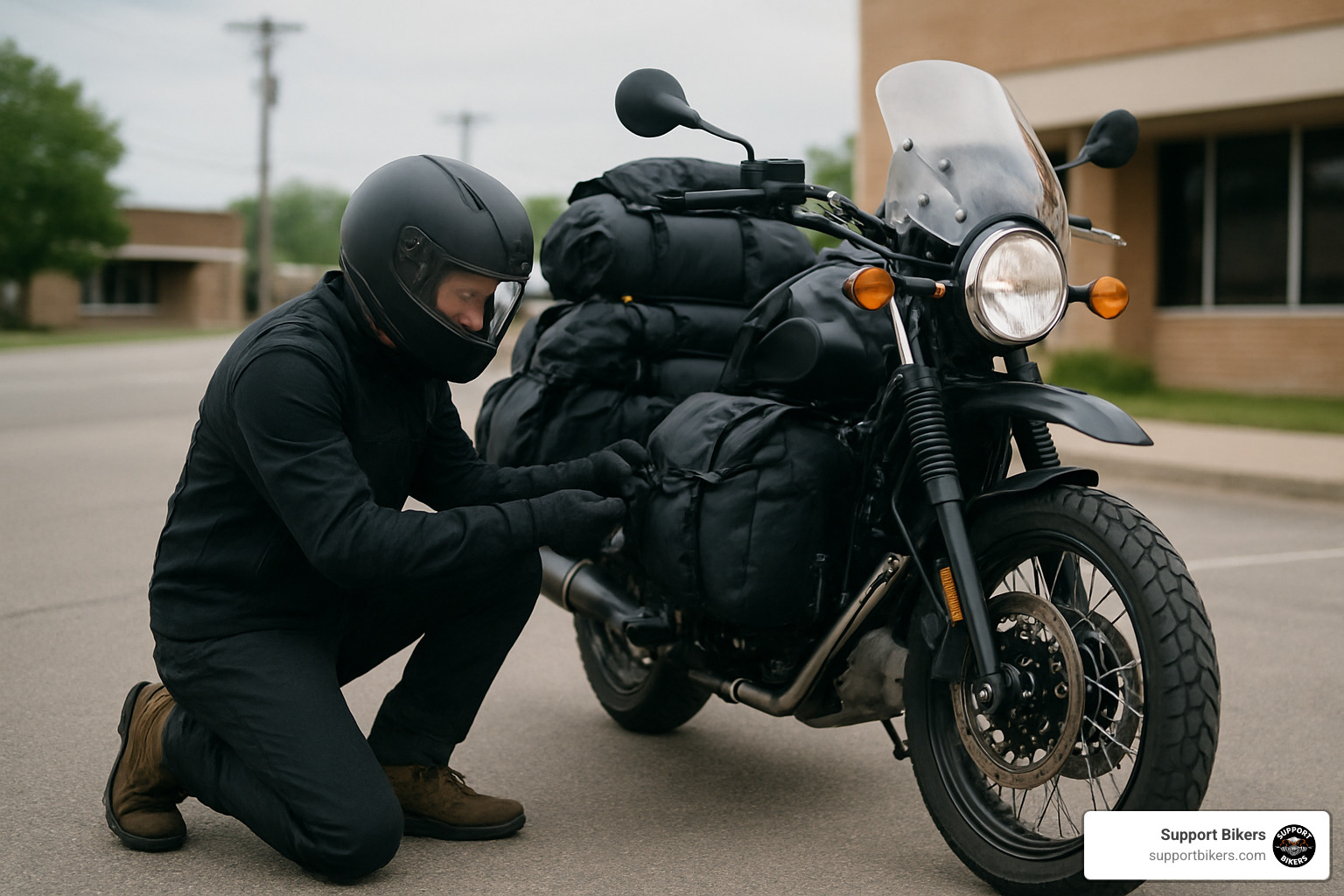
“The best motorcycle trips aren’t about perfect planning,” says veteran rider Jack Thompson. “They’re about having enough of what you need to handle the unexpected, while leaving room for the experiences you didn’t plan for.”
We at Support Bikers understand the unique challenges riders face when preparing for the open road. Our directory connects you with motorcycle-friendly businesses and resources across the country—from that small-town mechanic who’ll stay open late to get you back on the road to accommodations that won’t bat an eye when you roll up covered in road grime.
Whether you’re planning that weekend escape to the mountains or starting on the cross-country odyssey you’ve dreamed about for years, how you pack fundamentally shapes your experience. When your gear is thoughtfully organized, you’re free to immerse yourself in the journey rather than wrestling with your luggage.
As riders often remind each other: “First lay out everything you think you need, then put half of it back.” Trust in your resourcefulness and ability to adapt. You’ll be amazed at how little you actually miss those “essential” items left behind.
Ready to put these packing principles to the test? Explore our motorcycle routes USA to find your perfect next trip. Our community of fellow riders stands ready to support you through every mile and memory.
Help support injured riders through our Wrecked Rider Fund


0 Comments