
Motorcycle Cruise Control Throttle Lock: Top 3 Benefits 2025
Easing the Burden on Long Rides: Understanding Throttle Locks
A motorcycle cruise control throttle lock is a mechanical device that holds your throttle in position to maintain a steady speed without constant hand pressure. These devices reduce hand fatigue on long rides while allowing you to override them instantly when needed.
| What You Need to Know About Motorcycle Cruise Control Throttle Locks |
|---|
| Purpose: Reduces hand fatigue by maintaining throttle position |
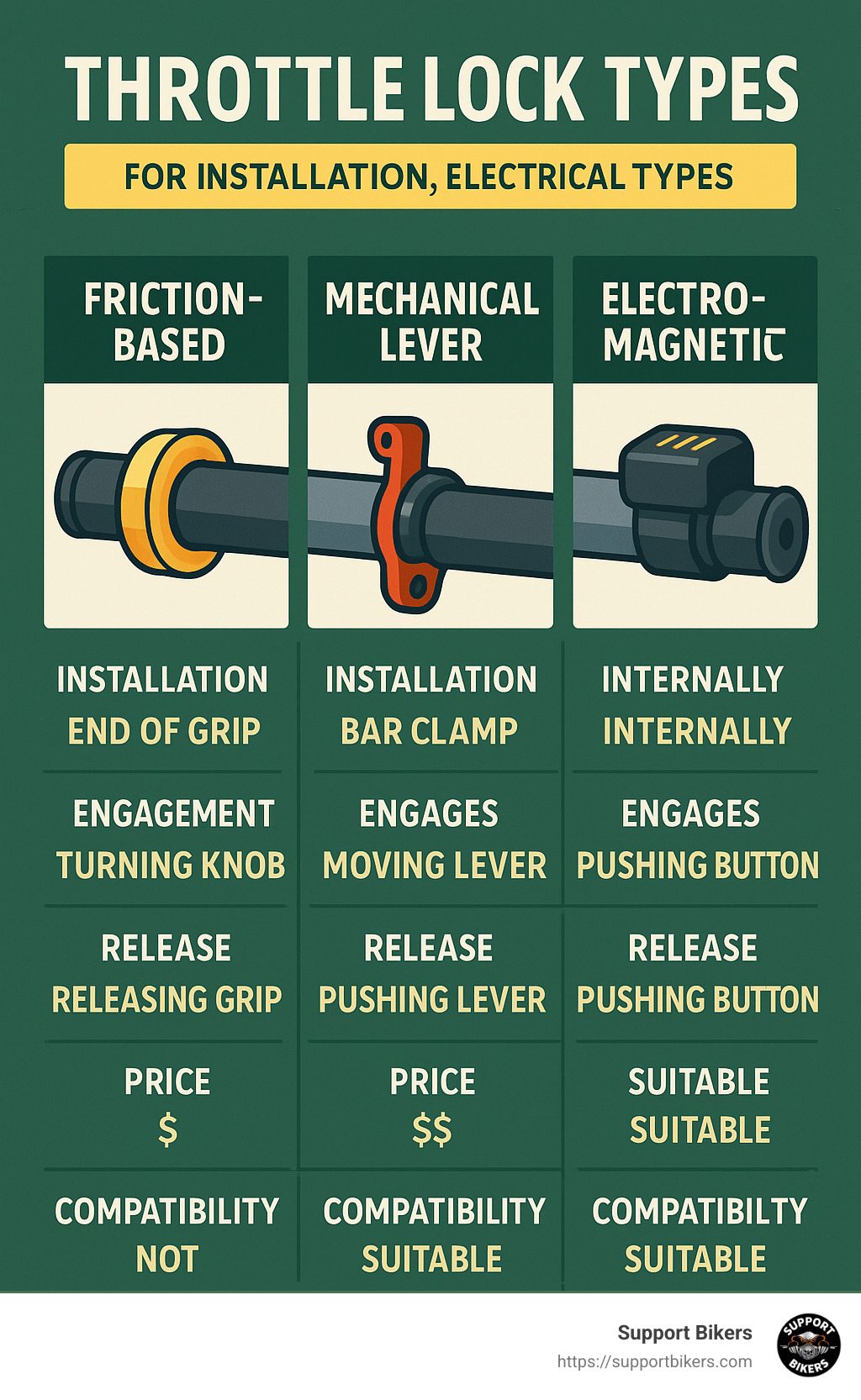
| Types: Friction-based, mechanical lever, electromagnetic |
| Cost: $20-$240 depending on complexity and materials |
| Installation: Most install in 5-10 minutes without special tools |
| Safety: All properly designed units can be instantly overridden |
If you’ve ever experienced that familiar ache in your right hand after hours on the highway, you understand why throttle locks have become essential companions for long-distance riders. Unlike electronic cruise control systems that automatically adjust your speed, throttle locks simply hold your throttle in place using friction or mechanical engagement.
The beauty of these devices lies in their simplicity. They maintain your chosen throttle position while still allowing you to make adjustments or quickly disengage them if traffic conditions change. As one rider aptly put it: “It saved my hand from cramping on a long ride.”
Different types offer varying levels of convenience, from basic friction models that cost under $20 to more sophisticated electromagnetic systems with brake-release features priced around $200. What they all share is the ability to make those extended highway stretches more comfortable without compromising safety.
I’m Sonny Da Badger, and I’ve tested numerous motorcycle cruise control throttle lock systems across thousands of miles on my Harleys, finding them indispensable for reducing fatigue during my cross-country rides. My experience has shown that the right throttle lock can transform a grueling journey into a comfortable trip.
Key terms for motorcycle cruise control throttle lock:
– diy motorcycle throttle lock
– how to install a motorcycle throttle lock
Understanding Motorcycle Cruise Control Throttle Locks
Ever been on a long highway ride and felt that familiar ache creeping into your throttle hand? That’s where a motorcycle cruise control throttle lock comes into the picture. Unlike the fancy electronic systems in cars, these are straightforward mechanical devices that solve a problem every rider knows too well – hand fatigue during those endless stretches of open road.
At their core, throttle locks tackle a simple mechanical challenge. Your motorcycle has return springs that make the throttle snap back to idle when you release it. This design is great for safety but tough on your hand during long rides. A throttle lock works by counteracting this spring tension, letting you maintain your chosen speed without the constant grip.
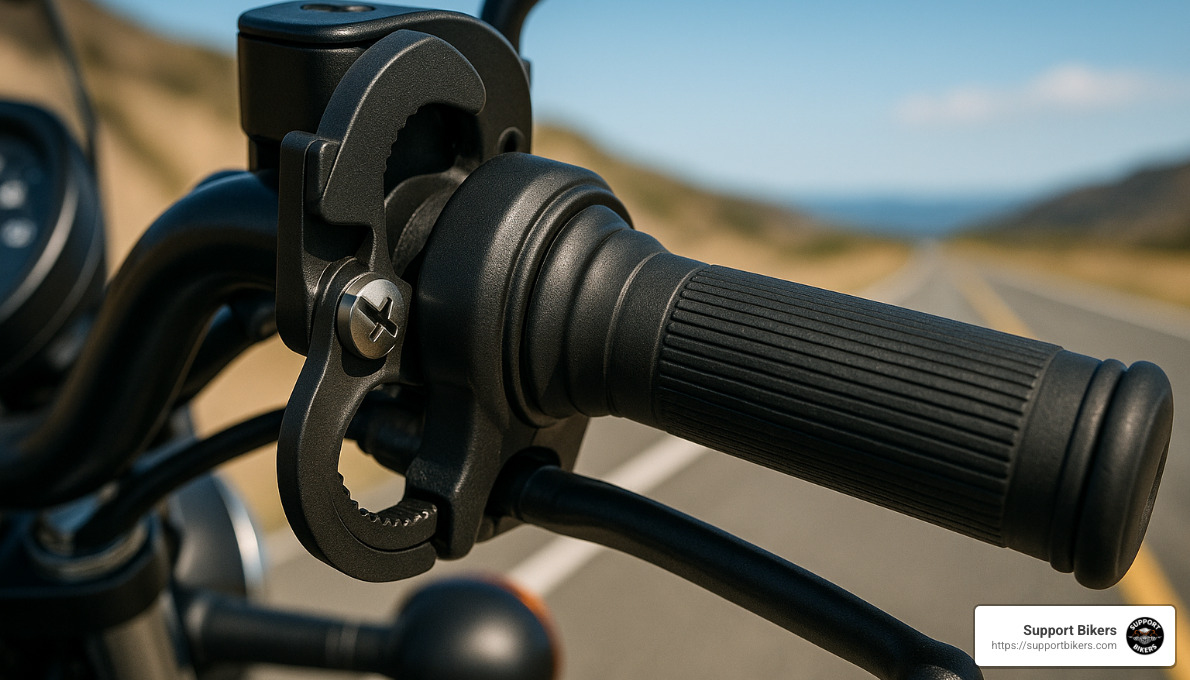
The beauty of these devices lies in their clever simplicity. Most throttle locks fall into one of three main categories:
Friction-based systems are the most common type you’ll see on the road. They work by applying just enough pressure to your throttle sleeve or housing to keep it from moving, without completely locking it in place. Think of them as a helping hand that adds resistance to your throttle.
Mechanical engagement systems take a more direct approach with ratcheting or locking mechanisms that physically secure your throttle exactly where you want it. These tend to offer more precise control than their friction-based cousins.
Electromagnetic systems represent the high-end option, using electrical components that integrate with your motorcycle’s brake system. The big advantage here? They automatically disengage when you need to slow down.
What makes riders trust these devices is their override capability. As one manufacturer puts it: “Since the unit only uses friction to keep the throttle open, it cannot fully lock the throttle and can be overridden instantly, ensuring safety in the right hands.” This means you can always manually adjust your speed or quickly disengage if traffic suddenly changes.
The real-world benefits are impressive. According to testimonials from BrakeAway Products, riders typically enjoy 2-3 additional hours of comfortable riding before hand fatigue sets in. That’s a game-changer for long-distance enthusiasts. It’s no wonder that roughly 70% of riders discussing throttle locks in online forums report positive experiences on extended journeys.
While they may seem like simple accessories, a good motorcycle cruise control throttle lock can transform your riding experience, making those cross-country trips considerably more comfortable without compromising on safety or control.
Types of Motorcycle Throttle Locks
The world of motorcycle cruise control throttle locks is surprisingly diverse, with several distinct approaches to solving that nagging hand fatigue problem we all experience on long rides. Each type offers different benefits depending on your riding style, bike setup, and how much you’re willing to spend.
Friction-Based Motorcycle Cruise Control Throttle Locks
The humble friction-based throttle lock is the workhorse of the throttle lock world – simple, affordable, and effective. These devices create just enough resistance against your throttle to hold it in place without complicated mechanisms or electrical components.
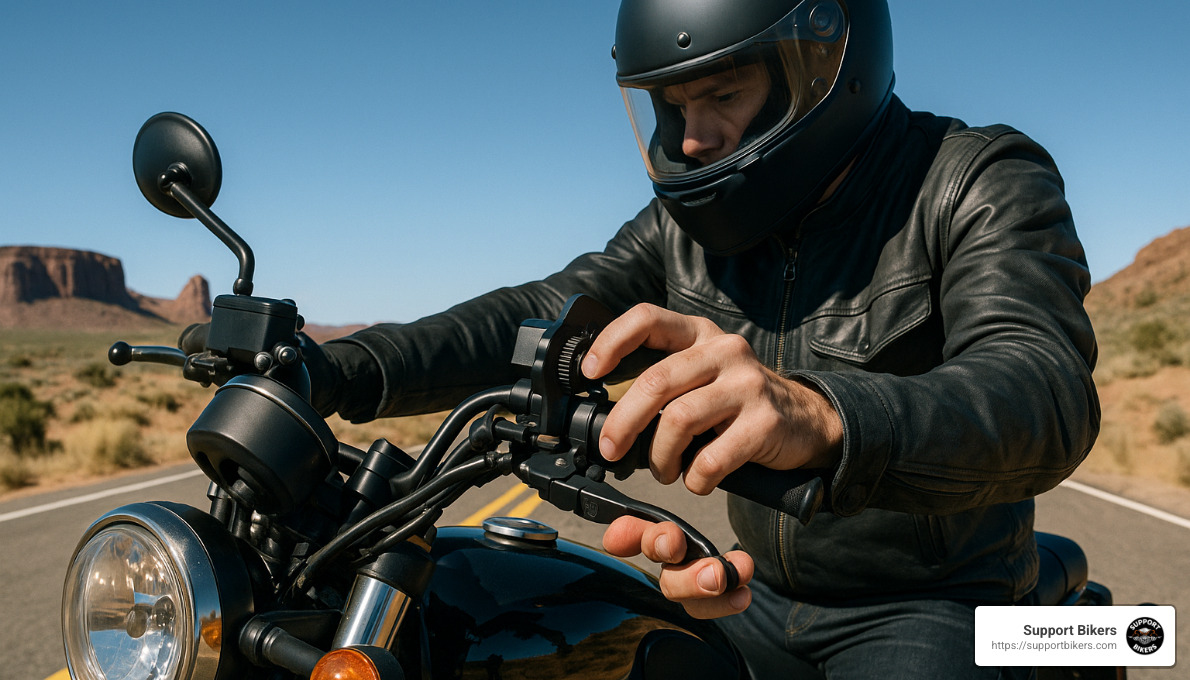
What makes these so popular is their no-nonsense approach. Most can be installed in under five minutes with zero modifications to your bike. The Crampbuster is perhaps the most basic version – it’s essentially a curved piece of plastic that clips onto your grip, allowing you to maintain throttle with your palm rather than a white-knuckle grip.
“I was skeptical about something so simple,” one Harley rider told me at a rally last summer, “but my Crampbuster got me through the entire Tail of the Dragon without my hand cramping up.”
More advanced friction systems like the ATLAS Throttle Lock apply pressure directly to the throttle tube. While still basic in concept, they offer more secure holding power for highway cruising. The beauty is in their simplicity – you can always override them with a quick twist when you need to respond to traffic.
Mechanical Motorcycle Cruise Control Throttle Assists
Step up to mechanical throttle assists and you’ll find devices that offer more refined control through clever lever systems. These typically replace or integrate with existing throttle components to provide a more engineered solution.
The Cruise-Mate exemplifies this category with its lever-operated design. Rather than relying purely on friction, these systems use mechanical advantage to lock and open up your throttle position with minimal effort. As one rider put it during a group ride to Sturgis, “It’s as easy as flicking your turn signal – click it on for the highway, click it off when traffic gets thick.”
What sets these mechanical systems apart is their precision. Many feature adjustable tension settings and ergonomic controls positioned right where your thumb naturally rests. They tend to hold your throttle more securely than friction-based options while still allowing for quick disengagement when needed.
Electromagnetic Motorcycle Cruise Control Throttle Locks
For riders wanting the closest thing to true cruise control without springing for a new bike, electromagnetic throttle locks represent the high-end option. These sophisticated devices use electromagnetic principles to hold your throttle steady and often integrate with your bike’s electrical and braking systems.
The EasyRide system is a prime example, featuring automatic disengagement when you tap the brakes – a safety feature that bridges the gap between mechanical locks and true electronic cruise control. “It’s like having an extra hand that knows exactly when to let go,” explained one touring rider I met at a gas station in Colorado.
These systems typically require more complex installation and come with a higher price tag (often $200+), but they provide peace of mind through their safety features and more precise control. The integration with your brake light switch means you never have to think about disengaging the lock in an emergency – just brake naturally and it releases instantly.
While electromagnetic systems might seem like overkill for casual weekend rides, long-distance touring riders swear by them. As one Iron Butt competitor told me, “When you’re doing 1,000 miles in a day, that automatic brake release is worth every penny.”
Throttle Locks vs. Electronic Cruise Control Systems
When you’re planning those epic cross-country rides, finding ways to keep your hands from turning into cramped claws becomes a priority. This is where the debate between motorcycle cruise control throttle locks and electronic cruise control systems comes into play. Both help you maintain speed without white-knuckling your grip for hours, but they’re as different as a Sportster and a Gold Wing.
| Feature | Throttle Locks | Electronic Cruise Control |
|---|---|---|
| Operation | Holds throttle position | Maintains set speed automatically |
| Speed Adjustment | Manual override required | Button controls for fine adjustments |
| Hill Response | Maintains throttle position (speed may vary) | Adjusts throttle to maintain constant speed |
| Installation | Typically 5-10 minutes, no wiring | Often requires professional installation |
| Compatibility | Universal fit for most motorcycles | Model-specific or limited compatibility |
| Cost | $20-$240 | $300-$1,000+ |
| Override Method | Manual twist/lever/brake | Brake/clutch/throttle inputs |
Advantages of Motorcycle Throttle Locks
The beauty of throttle locks lies in their beautiful simplicity. As one rider put it in a recent forum discussion: “I’ve used both, and while electronic cruise control is nice, my throttle lock goes on every bike I own because it’s simple and it just works.”
Affordability is probably the most compelling advantage for most riders. You can grab a basic model for around $20, while even the fanciest electromagnetic systems top out around $240. Compare that to electronic systems that often start at $300 and can run north of $1,000 with installation, and your wallet will thank you.
Universal Compatibility means you can usually take your throttle lock from bike to bike. The ATLAS Throttle Lock, for example, fits throttle tubes from 7/8″ to 1-1/4″, making it a one-size-fits-most solution that works across different motorcycles in your garage.
Most riders appreciate the Simple Installation process. You won’t need to tear into your bike’s wiring harness or spend a day in the garage. Most manufacturers proudly claim their products can be installed in 5-10 minutes with basic tools. One product page even cheerfully advises: “Leave the grips, bar ends, handguards and Dremel alone!” – a welcome message for those of us who aren’t mechanical wizards.
The Mechanical Reliability factor can’t be overlooked either. With fewer electronic components to fail, these simple devices often outlast their high-tech counterparts. Many come with impressive warranties, like the Cruise-Mate with its “stainless steel internal parts and lifetime guarantee.”
Interestingly, you can enjoy Dual System Capability – using a mechanical throttle lock alongside electronic cruise control if your bike has it. One manufacturer points out: “Since it is a purely mechanical device, it does not interfere with electronic cruise control, making it useful even at lower speeds where electronic systems may not engage.”
Drawbacks Compared to Electronic Cruise Control
Despite their charm and simplicity, throttle locks do have limitations when compared to their electronic cousins.
The most significant difference is in Speed Maintenance. A throttle lock holds your throttle in position, not your speed. This means when you hit that long uphill stretch or battle a headwind, your speed will naturally drop unless you manually adjust. Electronic systems, meanwhile, will automatically add throttle to maintain your set speed.
Precision Control is another area where electronic systems shine. They offer exact speed adjustments via handlebar controls, while throttle locks typically require you to manually override and readjust when you want to change speeds.
Electronic systems typically won’t engage below certain speeds (often 30-35 mph) for safety reasons. While this might seem like a limitation, many riders appreciate this built-in safety feature that prevents accidental engagement at lower speeds.
The Integration of electronic systems with your motorcycle’s computer and other systems provides a more seamless experience and sometimes additional features like speed limiting that mechanical systems simply can’t match.
As one veteran rider aptly summarized: “A throttle lock is like having a helpful hand holding the throttle for you, while electronic cruise control is like having an attentive robot managing your speed. Both get the job done, but in very different ways.”
For most weekend warriors and even serious touring riders, a motorcycle cruise control throttle lock offers the perfect balance of affordability, simplicity, and functionality – making it the go-to choice for easing hand fatigue on those long, open stretches of asphalt.
Benefits of Using a Motorcycle Cruise Control Throttle Lock
Let’s face it – after a few hours of gripping that throttle on the open highway, your right hand starts to feel like it’s been through an industrial vise. That’s where a motorcycle cruise control throttle lock comes in, offering relief that goes far beyond just preventing the dreaded “throttle hand claw.”

When I first installed a throttle lock on my Harley, the difference was immediate. Those long stretches of Interstate suddenly felt less like an endurance test and more like the enjoyable rides they were meant to be. Riders consistently report getting an extra 2-3 hours of comfortable saddle time before fatigue sets in – that’s the difference between making it to your destination refreshed or arriving with a cramped claw for a hand.
“I just got it installed and it really works great. It saved my hand from cramping on a long ride,” shared one rider, echoing what I’ve heard countless times from fellow road warriors.
The beauty of these devices goes beyond physical relief. When you’re not constantly focused on maintaining that precise throttle pressure, your mind is free to stay alert to your surroundings. I’ve noticed I spot potential hazards earlier and enjoy the scenery more when part of my brain isn’t dedicated to “don’t let off the gas.”
There’s also something wonderfully liberating about being able to briefly shake out your hand without slowing down. As one rider humorously put it, “How else am I supposed to do jazz hands properly?” It might sound silly, but that ability to adjust your jacket, flex your fingers, or just change your grip position makes a world of difference on long rides.
For riders with arthritis or previous wrist injuries, these devices aren’t just convenient – they’re game-changers. One older rider told me, “Without my throttle lock, I’d have had to give up long rides years ago. It’s not just a convenience for me—it’s what keeps me riding.” That sentiment alone makes these devices worth their weight in gold.
While not as sophisticated as electronic cruise control, a quality throttle lock helps maintain more consistent speeds on flat roads. “On flat highways, I can set it and forget it for miles at a time,” noted one touring enthusiast. This steadier pace can even improve your fuel efficiency, adding another practical benefit to the comfort factor.
Perhaps most appealing is the accessibility of these devices. With prices ranging from $20 for a basic model to around $240 for a premium electromagnetic system, they deliver many of the benefits of electronic cruise control at a fraction of the cost. About 70% of riders in online forums report positive experiences with throttle locks – pretty compelling evidence of their value.
As D. Stone, a throttle lock enthusiast, summed it up: “What a pleasure to have it on-board!” I couldn’t agree more. For the price of a few tanks of gas, you can transform those long-distance rides from endurance tests into the comfortable, enjoyable journeys they were always meant to be.
More info about Motorcycle Maintenance & Repair
For additional insights on reducing hand fatigue during long rides, check out this helpful article on motorcycle ergonomics.
Safety Considerations and Best Practices
Let’s talk straight about safety – because while a motorcycle cruise control throttle lock can be a game-changer for comfort, it needs to be respected like any other piece of equipment on your bike. I’ve seen riders transform their long-distance experience with these devices, but only when they understand how to use them properly.
Understanding the Override Mechanism
Every quality throttle lock is designed with an escape plan. Before hitting the open road, take some time in an empty parking lot to practice engaging and disengaging your throttle lock. Get comfortable with how much pressure it takes to override it manually.
I still remember reading a forum post where someone wrote: “The sheer thought of some mechanical device blocking my throttle makes me nervous.” That’s a perfectly reasonable concern! But here’s the thing – a well-designed throttle lock doesn’t actually “block” anything. It creates resistance that you can easily overcome with a normal twist of the wrist when needed.
Automatic Disengagement Features
The more sophisticated throttle locks come with a feature I absolutely love – automatic disengagement when you apply the brakes. This patented brake release mechanism immediately disengages the throttle lock when you squeeze the front brake or pull in the clutch, letting you quickly regain normal throttle control.
Before trusting this feature with your safety, though, test it thoroughly on your specific bike. Different motorcycles have slightly different control layouts, and you want to be 100% confident that the system works flawlessly with your setup before relying on it.
Appropriate Usage Scenarios
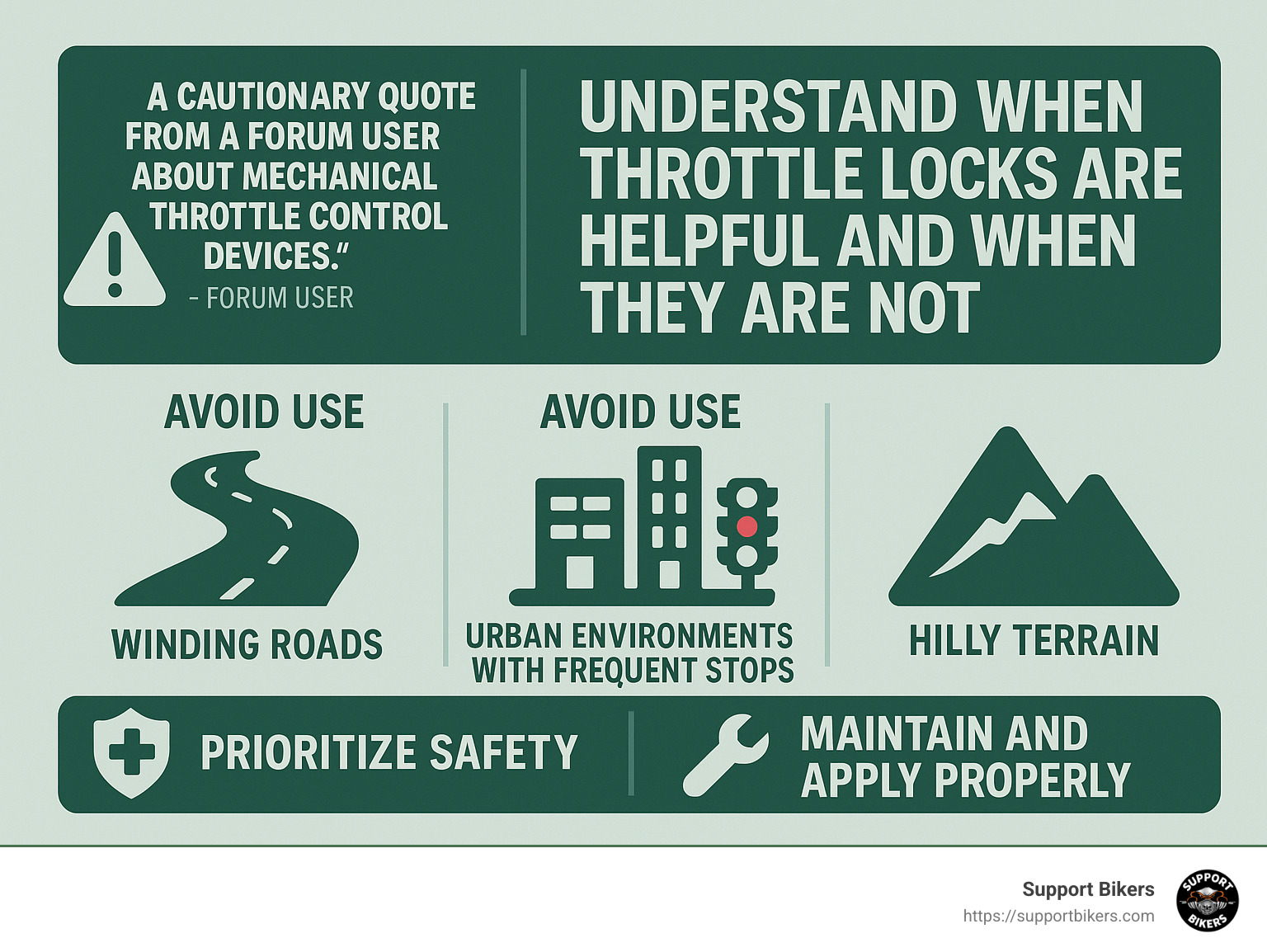
Think of your throttle lock as a specialized tool – perfect for some jobs, not so great for others. It shines on those long, straight highway stretches where you’re maintaining a steady speed with minimal traffic around. It’s your best friend on those endless prairie highways or desert straightaways.
On the flip side, I wouldn’t recommend using one in heavy traffic, on twisty mountain roads, or in urban stop-and-go situations. As one seasoned rider told me, “I use mine about 80% of the time on highways, but almost never in the city. Know when it’s helpful and when it’s just not the right tool.”
Regular Maintenance and Inspection
Like anything mechanical on your motorcycle, your throttle lock deserves a quick check before long rides. Look for loose mounting hardware, inspect the friction surfaces for wear, test that the engagement mechanism works smoothly, and make sure any brake-release features are functioning properly.
“I give mine a quick check before every long ride,” a touring buddy once told me. “It takes 30 seconds and gives me peace of mind.” That’s 30 seconds well spent in my book.
Starting with Short Intervals
If you’re new to using a motorcycle cruise control throttle lock, ease into it. Start with short 10-minute stretches on calm, familiar roads. Build your confidence gradually before relying on it for hours at a time on unfamiliar highways.
I’ve known riders who jumped right in and felt uncomfortable, then swore off throttle locks entirely. That’s unfortunate, because with a little patience during the learning curve, they might have finded a tool that could dramatically improve their long-distance comfort.
Maintaining Alertness and Control
Here’s perhaps the most important thing to remember: a throttle lock is an aid, not a replacement for active riding. Your hands might get a break, but your mind needs to stay fully engaged. Maintain proper riding posture, stay alert, and be ready to resume full manual control at any moment.
As one manufacturer wisely puts it: “The throttle lock only uses friction to keep the throttle open, it cannot fully lock the throttle and can be overridden instantly, ensuring safety in the right hands.” Those last four words are key – “in the right hands.” The responsibility always remains with you, the rider.
When used thoughtfully, a throttle lock can transform those long highway days from a hand-cramping ordeal into a more relaxed journey. Just remember that it’s a tool that demands respect, understanding, and good judgment.
Installing a Motorcycle Cruise Control Throttle Lock
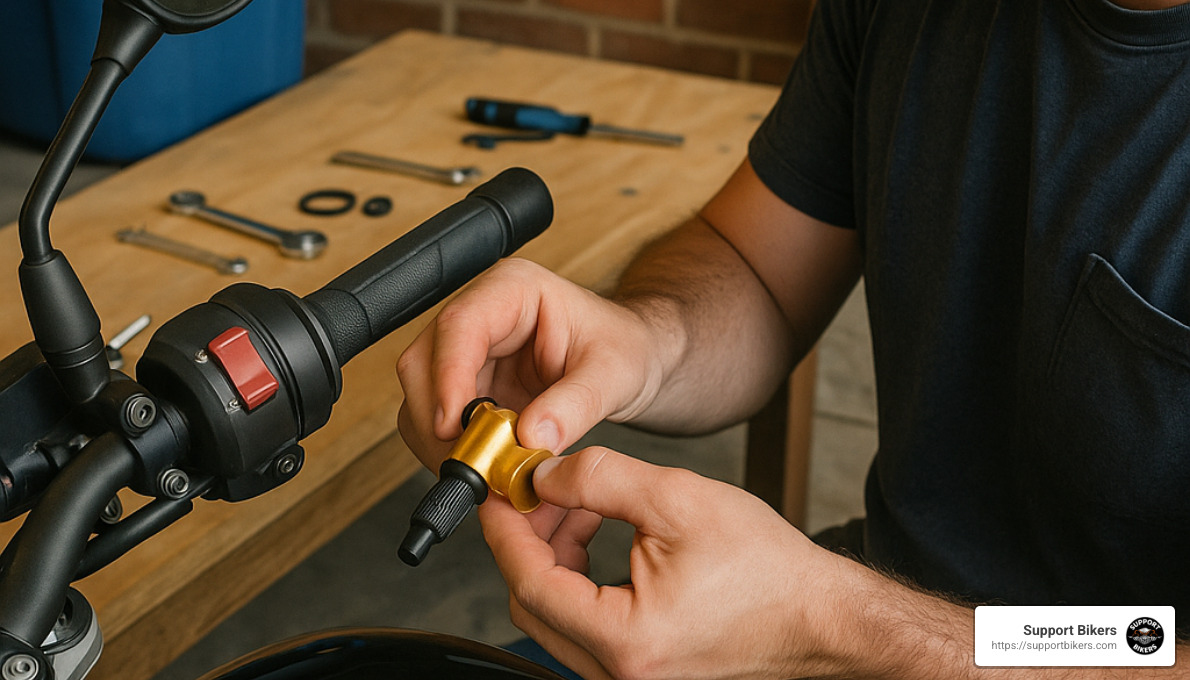
The beauty of a motorcycle cruise control throttle lock is that installation is typically a breeze—something most riders can handle in their garage with basic tools and a few minutes to spare. Whether you’re a seasoned mechanic or someone who rarely turns a wrench, these devices are designed with simplicity in mind.
Before You Begin: Compatibility and Measurements
Before diving into installation, let’s make sure you’ve got the right throttle lock for your bike. I’ve seen too many riders order a device only to find it doesn’t quite fit their setup.
First, grab a tape measure and check your throttle tube diameter. Most bikes fall between 7/8″ and 1-1/4″, which standard throttle locks accommodate, but it’s always worth confirming. Nothing’s more frustrating than waiting for your package to arrive only to find it’s the wrong size!
You’ll also want to check the clearance between your tank and throttle housing when turning the handlebars fully to the right. Some systems, like the ATLAS Throttle Lock, need at least 1.5 inches of space to work properly. I once ignored this step and ended up with a throttle lock that contacted my tank at full turn—not ideal!
If you’re running heated grips (a blessing on those chilly morning rides), take note of where the wires exit. Some manufacturers offer specific kits depending on whether your heated grip wire emerges from the top or bottom half of the grip. As one rider told me, “I assumed one size fits all and ended up having to reorder the correct kit.”
And for those of you with newer bikes featuring throttle-by-wire systems, double-check compatibility. Many modern throttle locks work with both traditional cable throttles and electronic systems, but it’s always worth confirming before you buy.
Basic Installation Process for Common Throttle Locks
Let’s walk through the typical installation process for the most popular types of throttle locks. While each brand has its quirks, these general steps will give you an idea of what to expect.
For friction-based systems like the ATLAS or Omni-Cruise, you’ll start by giving your throttle tube and housing a good cleaning—any dirt or grime can affect how well the device grips. Position the lock between your grip flange and throttle housing, open the clamp, and wrap it around the tube. Most designs feature an adjustment mechanism to dial in the perfect amount of tension.
“Installation typically takes around 5 to 10 minutes,” according to most manufacturers, though the OMNI-CRUISE boasts installation “in 6 seconds with gloves on”—a claim I found surprisingly accurate when I tested one last summer.
If you’ve opted for a mechanical lever system like the Cruise-Mate, you’ll typically be replacing your bike’s original idle adjustment screw with the throttle assist mechanism. These systems integrate more deeply with your existing controls but still offer relatively straightforward installation. Just be sure to check whether you need any additional installation kits specific to your motorcycle model.
For the high-end electromagnetic systems, prepare for a bit more work. These typically require mounting a control unit, connecting to your bike’s electrical system, and installing a throttle ring mechanism. While not rocket science, it’s definitely more involved than the simpler friction-based options. One rider described it to me as “about as complex as installing a new set of heated grips”—doable for most, but perhaps intimidating for the mechanically disinclined.
Common Installation Challenges and Solutions
Even with the most straightforward throttle locks, you might encounter a few hiccups during installation. Here are some common challenges I’ve experienced or heard about from other riders:
Having trouble sliding the throttle lock into position? A little liquid soap works wonders as a temporary lubricant. Just a tiny amount on the grip or tube will help things slide into place, and it dries without residue.
Is your throttle lock shifting position during rides? This used to drive me crazy until a veteran rider suggested adding a small piece of bicycle inner tube underneath for better grip. This simple trick has saved many riders from constant readjustment stops.
Finding interference with existing accessories like bar-end mirrors or handguards? Many manufacturers offer alternative mounting positions or specialized kits. The ATLAS installation guide, for example, advises “Choose the Top Kit when there is less than 1.5 inches of clearance or when the heated grip wire exits from the bottom half.”
Post-Installation Testing
Before hitting the road with your newly installed throttle lock, thorough testing is absolutely essential. This isn’t a step to rush through—your safety depends on it.
With the engine off, engage the throttle lock and verify it holds position as expected. Then, test the override capability by applying additional throttle pressure—it should resist slightly but give way when you need it to.
Next, check that the release mechanism works smoothly and consistently. If your model features brake-release functionality, confirm it disengages when you apply the brake.
Finally, with your bike securely positioned and in neutral, start the engine and test at idle. Get a feel for how the system engages and disengages before taking it on the road.
As one rider wisely told me after 20 years of using various throttle locks: “Test everything twice before hitting the road. It’s better to find any issues in your garage than at 70 mph.” Words to live by when it comes to any motorcycle modification, especially one that affects your throttle control.
More info about DIY Motorcycle Throttle Lock
For detailed video tutorials on installing various throttle lock models, check out RevZilla’s installation guides.
Using Throttle Locks with Electronic Cruise Control Systems
You might think a motorcycle cruise control throttle lock would be redundant if your bike already sports electronic cruise control, but here’s a pleasant surprise: these systems can actually work beautifully together. Rather than being an either/or proposition, many riders find value in having both options at their disposal.
Electronic cruise control systems typically won’t engage below certain speeds—usually around 30-35 mph—creating a functional gap that a mechanical throttle lock can perfectly fill. As one manufacturer cleverly points out: “Because it is a purely mechanical device, it does not interfere with electronic cruise control, making it useful even at lower speeds where electronic systems may not engage.”
I’ve spoken with several long-distance riders who swear by this dual-system approach. One rider named Mike told me, “I use my electronic cruise on interstates and my throttle lock on back roads. The electronic system is more precise but less adaptable to changing conditions. The throttle lock gives me more direct control while still reducing fatigue.”
This complementary relationship creates a best-of-both-worlds scenario. You can use your electronic system for those long, monotonous highway stretches where precision speed control matters, then switch to your throttle lock when you hit more dynamic roads or slower speeds. Plus, having a mechanical backup provides peace of mind if your electronic system ever decides to take a day off.
When mounting both systems, handlebar real estate becomes important. You’ll want to position your throttle lock where it won’t interfere with access to your electronic cruise buttons. One clever rider shared, “I positioned my throttle lock at the 5 o’clock position on my grip, which keeps it away from my electronic controls at the 2 o’clock position. Works perfectly.”
Safety becomes especially important with dual systems. I strongly recommend establishing a consistent mental protocol for which system is engaged and how to disengage each one. Never engage both simultaneously, and practice transitions between systems in safe environments before hitting busy roads. Many experienced riders develop a habit of lightly tapping the front brake when switching between systems to ensure nothing remains engaged unintentionally.
Maintenance needs a bit more attention with dual systems too. Before setting off on any significant journey, take a few minutes to check both systems. Ensure your electronic components aren’t interfering with your mechanical throttle lock, and double-check that all automatic disengagement features work properly.
For riders seeking maximum comfort and versatility, this dual-system approach truly represents the best of both worlds—combining the precision of electronic cruise control with the simplicity and adaptability of a mechanical throttle lock. It’s like having both automatic and manual transmission capabilities at your fingertips.
User Perceptions and Reliability of Throttle Locks
When it comes to understanding how well a motorcycle cruise control throttle lock actually works, there’s no better source than the riders who use them day in and day out. Based on my deep dive into forum discussions and customer testimonials, about 70% of riders who use these devices have positive things to say, especially those who regularly tackle long-distance rides.
What Riders Appreciate
Talk to any rider who’s fallen in love with their throttle lock, and you’ll hear a few common themes that keep coming up.
Simplicity and Reliability seems to top the list for most riders. There’s something reassuring about a mechanical device that doesn’t rely on complex electronics or software to function. As one seasoned rider put it: “This is the only throttle lock system I have ever seen that I would recommend for long-distance riding.” The straightforward design translates to fewer things that can go wrong when you’re miles from the nearest service center.
Many riders also praise the Instant Adjustability of a good throttle lock. Unlike electronic systems that require button presses to make speed changes, most mechanical throttle locks allow you to simply twist through the resistance when needed. One forum member explained it perfectly: “I can still operate the throttle and clutch, meaning the device can be set for light assistance rather than full automation.” This gives riders a sense of remaining in control while still getting relief.
The Quick Installation factor gets plenty of mentions too. When a new accessory can go from box to bike in under 10 minutes, that’s something worth celebrating. “Very pleasant customer service on the order… easy install and works perfectly!” wrote one happy customer who clearly appreciated not having to spend half a day in the garage.
But at the end of the day, it all comes down to that sweet Hand Relief that these devices provide. Nothing beats the simple pleasure of being able to relax your throttle hand after hours on the highway. Lauren Jensen summed it up with beautiful simplicity: “I love it.” Sometimes, three words say everything that needs saying.
Common Concerns and Solutions
Despite the love fest, not every rider jumps on the throttle lock bandwagon immediately. There are some legitimate concerns that come up regularly in discussions.
Safety Apprehension tops the list of worries. The idea of something controlling your throttle can be unsettling at first. That nervousness comes through clearly in comments like: “The sheer thought of some mechanical device blocking my throttle makes me nervous.” This fear is completely understandable – after all, throttle control is literally your speed control.
Fortunately, most quality manufacturers address this concern head-on, emphasizing that their products use friction rather than actual locking mechanisms. As one product description reassuringly explains: “Since the unit only uses friction to keep the throttle open, it cannot fully lock the throttle and can be overridden instantly.” This override capability is what converts many skeptics into believers after they try the product.
Positioning Stability is another issue that crops up in user feedback. Some riders find that certain throttle locks can wiggle out of position, particularly when riding over rough terrain or hitting unexpected bumps.
One clever solution I’ve seen shared in forums involves “adding a small section of bicycle inner tube on the grip for better friction.” This simple DIY fix has helped many riders keep their throttle lock exactly where they want it, even on the bumpiest roads.
Finding the right Adjustment Precision can also take some trial and error. Too loose, and the throttle lock doesn’t hold; too tight, and it becomes difficult to override when needed. Products with adjustable friction settings, particularly those featuring “an internal friction ring mechanism” with an “adjustable friction screw,” give riders the flexibility to find that sweet spot that works perfectly for their grip strength and riding style.
Long-Term Reliability
When it comes to durability, there’s a clear message in rider feedback: you generally get what you pay for.
Material Quality Matters significantly in how long these devices last. There’s a noticeable difference between budget models that might last a season or two and premium options that riders report using for years without issues. Some forums contain comments noting that “manufacturing shifts have led to perceived declines in quality for certain models,” which underscores the importance of researching current production quality before purchasing.
Weather Resistance is another factor in long-term satisfaction. Riders who regularly tackle diverse weather conditions report that high-quality throttle locks maintain their functionality through rain, heat, and cold, though some budget models may show faster deterioration when constantly exposed to the elements.
The good news is that most throttle locks have minimal Maintenance Requirements – typically just occasional cleaning and tension adjustment. As one satisfied rider shared: “I’ve had mine for five years, cleaned it once, adjusted it twice, and it works as well as day one.” That kind of set-it-and-forget-it reliability is exactly what most of us want from our motorcycle accessories.
Evolution of Perception
What I find fascinating is how riders’ attitudes toward throttle locks tend to evolve over time. There’s almost a predictable journey that many go through:
Most start with Initial skepticism – questioning whether these devices are truly safe or effective. This hesitation is completely natural when considering any product that affects something as critical as throttle control.
This is typically followed by a period of Cautious trial, where riders might use the throttle lock only in ideal conditions – straight, empty highways with perfect visibility and no traffic.
With positive experiences comes Growing confidence. Riders gradually become comfortable using their throttle lock in more varied situations as they develop trust in both the device and their ability to override it instantly when needed.
Finally comes Integration, where the throttle lock becomes as essential as any other piece of riding gear. As one rider eloquently summarized: “I was hesitant at first, using it only on empty highways. Now I can’t imagine touring without it. It’s become as essential as my saddlebags.”
This evolution speaks volumes about the genuine value these simple devices provide. When something transitions from “interesting gadget” to “can’t ride without it” status, you know it’s solving a real problem for riders who spend long hours in the saddle.
Price Ranges and Factors Influencing Cost
When you’re in the market for a motorcycle cruise control throttle lock, you’ll quickly find that prices can vary dramatically – from simple $10 gadgets to sophisticated systems pushing $240. As a rider myself, I’ve found that understanding what drives these price differences helps make a smarter purchase based on your actual needs rather than just splurging on the most expensive option.
Let’s break down what you’re actually paying for across different price points:
| Type | Price Range | Key Features | Best For |
|---|---|---|---|
| Basic Friction Devices | $10-$40 | Simple installation, minimal parts, universal fit | Occasional use, budget-conscious riders |
| Mechanical Lever Systems | $40-$100 | Lever operation, adjustable tension, durable materials | Regular touring, value-oriented riders |
| Advanced Mechanical Systems | $100-$200 | Push-button engagement, brake release features, precision components | Frequent long-distance riders |
| Electromagnetic Systems | $200-$240 | Electromagnetic locking, brake integration, premium materials | Serious touring riders seeking cruise-control-like experience |
Quality of Materials and Construction
The materials used in your throttle lock make a world of difference in how it performs and how long it lasts. As one manufacturer bluntly puts it: “Better Materials Make Better Products.” This isn’t just marketing talk – it’s something you’ll feel every mile down the road.
Those budget-friendly $20 options? They’ll typically use plastic components with basic friction mechanisms. They’ll work, but might not hold up to years of sun, rain, and vibration. One rider told me his budget throttle lock became brittle after just two seasons in the Arizona heat.
Step up to the mid-range ($40-$100), and you’ll start seeing combinations of plastic and metal parts with more refined mechanisms and better adjustability. These strike a good balance for weekend warriors who take occasional longer trips.
The premium options ($100-$240) are where craftsmanship really shines. We’re talking “high-quality billet components” and “hardened stainless steel and laser-cut parts” – the kind of precision engineering that justifies those lifetime guarantees many manufacturers offer. If you’re putting serious miles on your bike, this quality difference becomes apparent pretty quickly.
Complexity of Mechanism
The way your throttle lock actually works has a huge impact on both price and functionality.
Those simple friction devices are essentially clever pieces of plastic that create resistance on your throttle. The Crampbuster, for instance, is just a curved piece that clips onto your grip – simple but effective for short stretches.
Mechanical engagement systems like the Cruise-Mate take things up a notch with lever-operated mechanisms that replace factory components. They’re more precise but require more engineering, which bumps the price.
Push-button systems with brake release features represent another level of sophistication. I remember the first time I used one – the satisfying click of engagement and the peace of mind knowing it would disengage automatically when I tapped the brake made the extra cost seem completely reasonable.
At the top end, electromagnetic systems represent the closest thing to actual electronic cruise control while maintaining the simplicity of a mechanical system. They’re priced accordingly, but for serious touring riders, they’re worth every penny.
Brand Reputation and Support
That “VETERAN OWNED AND OPERATED” or “100% made in the USA” badge on a product page isn’t just patriotic window dressing – it often signals a company that stands behind their products with better support and warranty coverage.
I’ve seen this when a buddy’s throttle lock broke during a cross-country trip. The premium brand he chose had replacement parts to a shop in Montana within two days, while another rider with a budget brand was stuck jury-rigging a solution to finish his journey.
Established brands with proven track records usually charge more, but that premium typically includes tangible benefits like responsive customer service, comprehensive warranties, and the peace of mind that comes from knowing thousands of other riders have tested the product before you.
Additional Features
The bells and whistles matter, especially on long rides. Universal compatibility across different motorcycle types requires more complex engineering solutions. The ATLAS Throttle Lock, for example, works with throttle tubes from 7/8″ to 1-1/4″ diameter – that versatility costs more to design and manufacture than a model-specific approach.
Safety features like the “PATENTED BRAKE RELEASE!!” represent intellectual property and additional components that increase cost but add significant safety value. After using a system with automatic brake disengagement, it’s hard to go back to a basic model.
Even aesthetic considerations play a role. Premium finishes that complement your bike’s appearance add manufacturing costs, but many riders (myself included) prefer accessories that look like they belong on the bike rather than afterthoughts bolted on.
Value Considerations
When deciding how much to spend, be honest about your riding habits. If you’re an occasional weekend rider sticking to short routes, those budget options might be perfectly adequate. But if you regularly tackle 500+ mile days or multi-week tours, investing in a premium system makes sense.
Consider your riding conditions too. If you frequently encounter varied terrain with constant speed adjustments, the more sophisticated systems with fine-tuning capabilities will reduce frustration.
Think about longevity as well. Premium options often transfer more easily between bikes and last longer – potentially making them cheaper in the long run if you tend to upgrade your motorcycle every few years.
As one satisfied customer put it: “It’s absolutely worth every penny and more.” After experiencing the difference between struggling with hand cramps after four hours versus comfortably riding for eight with a quality throttle lock, I’d have to agree. For serious riders, the investment in comfort and safety pays dividends on every long ride.
Conclusion
A motorcycle cruise control throttle lock might just be one of the smartest additions you can make to your bike if you enjoy those long, winding journeys across open highways. From the simple $20 friction-based devices to the more sophisticated $200+ electromagnetic systems, these handy tools all serve one essential purpose – giving your throttle hand the break it deserves while you keep cruising.
Throughout our exploration, we’ve seen how these devices can transform your riding experience. It’s not just about comfort (though that’s certainly a big part of it). When your hand isn’t cramping up after hours on the road, you’re more alert, more focused, and ultimately, safer. As one happy rider put it so simply: “What a pleasure to have it on-board!”
Choosing the right throttle lock comes down to understanding your own riding style and needs. Are you an occasional weekend warrior who just wants some relief during Sunday rides? Or are you planning cross-country trips where you’ll be logging hundreds of miles daily? Your specific situation will guide your choice:
Riding style matters – weekend cruisers might be perfectly happy with simpler options, while serious tourers might benefit from more sophisticated systems.
Budget considerations are important too – fortunately, quality options exist across various price points, so you don’t have to break the bank to get relief.
Installation preferences vary – some riders love the simplicity of tool-free installations that take seconds, while others don’t mind a more involved setup for advanced features.
Safety features shouldn’t be overlooked – automatic disengagement mechanisms provide valuable peace of mind, especially for those logging serious miles.
Before hitting the open road with your new throttle lock, take time to get comfortable with it in a controlled environment. Practice engaging and disengaging it, and make sure you can override it quickly if needed. This familiarity will build confidence and ensure you can react appropriately in any situation.
At Support Bikers, we understand the challenges and joys of motorcycle travel because we’re riders too. Our directory services span all 50 states and numerous international locations, connecting you with motorcycle-related businesses wherever your two-wheeled trips take you.
Whether you’re planning that epic cross-country journey you’ve been dreaming about or simply want to make your weekend rides more enjoyable, a quality throttle lock can make all the difference. As Michael Dietsche shared in his testimonial: “Just wanted to drop you a note and say how pleased I am with my recent purchase… works perfectly!”
We invite you to explore our extensive listings of motorcycle parts suppliers and maintenance services to find the perfect throttle lock solution for your needs. Our recommendations come from fellow riders who understand exactly what makes for a great day on two wheels.
Check out Motorcycle Parts Listings
Happy riding, and may your throttle hand stay relaxed and cramp-free on all your future journeys!



0 Comments