
Understanding the Motorcycle Accident Settlement Process: Your Path to Fair Compensation
The motorcycle accident settlement process is a legal pathway that allows injured riders to recover compensation without going to trial. Most motorcycle injury claims settle outside of court within six months to a year, though complex cases can take longer.
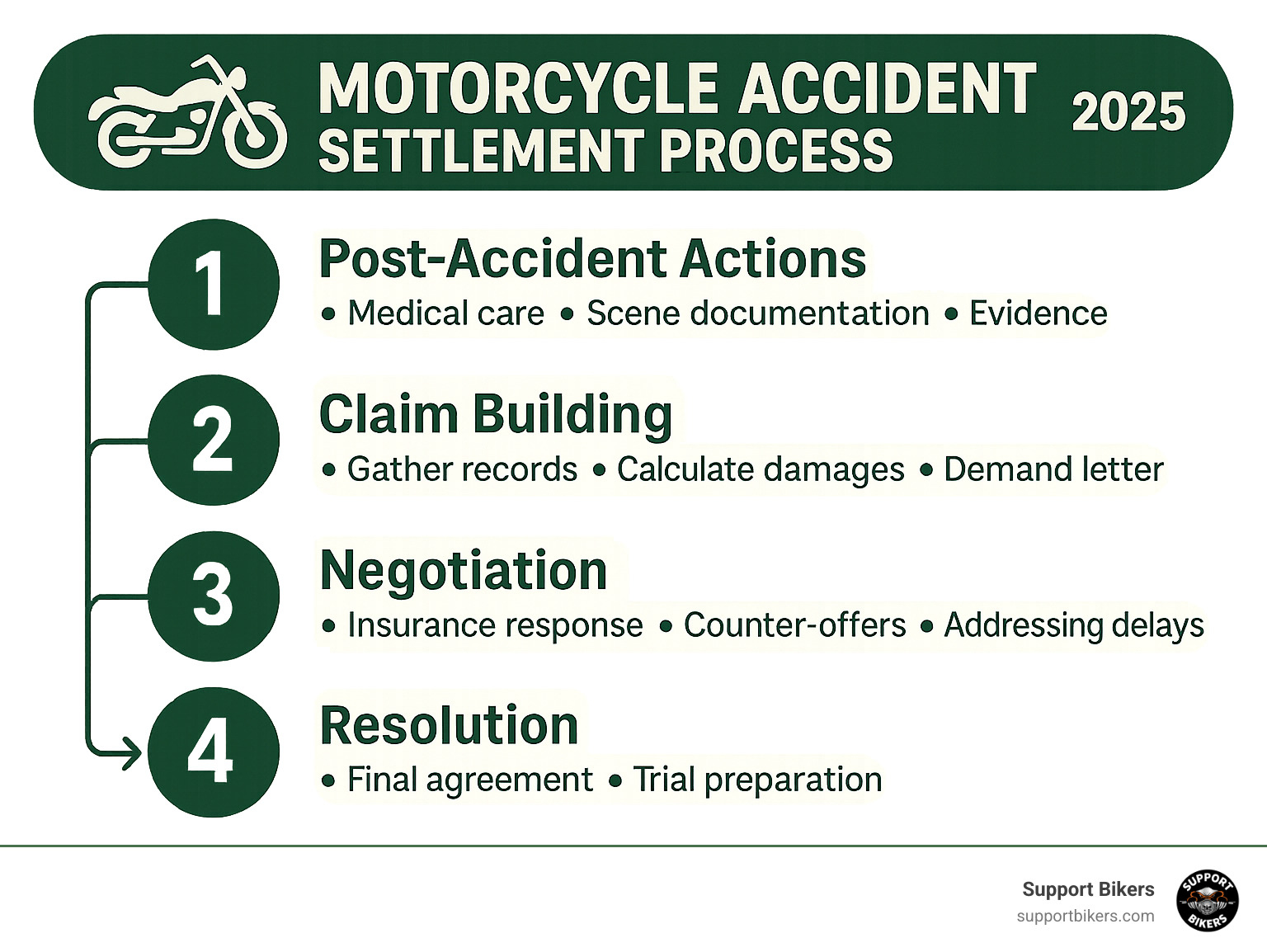
Here’s how the motorcycle accident settlement process works:
- Immediate Actions – Seek medical care, document the scene, gather evidence
- Claim Building – Compile medical records, calculate damages, issue demand letter
- Negotiation – Exchange offers with insurance companies, counter lowball settlements
- Resolution – Finalize agreement or proceed to trial if necessary
Motorcycle accidents present unique challenges. According to the National Highway Traffic Safety Administration (NHTSA), riders face a significantly higher risk of fatal injuries than occupants of passenger cars. They also often encounter bias from insurance adjusters who may view motorcyclists as reckless. The exposed nature of riding means injuries are typically more severe, leading to higher medical costs and longer recovery periods.
Settlement amounts vary widely based on injury severity:
- Minor injuries: $10,000 – $50,000
- Moderate injuries: $50,000 – $200,000
- Severe injuries: $200,000 – $1,000,000+
The process involves proving negligence, documenting all damages, and negotiating with insurance companies who often employ delay tactics and make initial lowball offers.
I’m Sonny Da Badger, founder of Support Bikers, and while I haven’t personally steerd the motorcycle accident settlement process, I’ve connected countless riders with experienced legal professionals who specialize in these complex cases. Through our community, I’ve learned how crucial it is for bikers to understand their rights and have proper representation when dealing with insurance companies during the motorcycle accident settlement process.
Relevant articles related to motorcycle accident settlement process:
What is a Motorcycle Accident Settlement?
After a motorcycle accident, a motorcycle accident settlement offers a path to financial recovery without a lengthy court battle. A settlement is a formal legal agreement where the at-fault party agrees to pay for your losses, including medical bills, lost wages, and pain and suffering. It provides the financial help you need to get back on your feet.
For most riders, a settlement is preferable to a trial. Trials can be long, stressful, and expensive, with an uncertain outcome. A settlement gives you more control, is generally faster, and resolves your claim privately, allowing you to focus on healing.
Here is a comparison between settling your case and taking it to trial:
| Feature | Settlement | Trial Verdict |
|---|---|---|
| Time | Typically 6 months to 1 year, sometimes faster | Can take 1-2 years or more to reach trial |
| Cost | Generally lower legal fees and expenses | Significantly higher legal fees and expenses |
| Privacy | Remains private between parties | Public record |
| Control | More control over the outcome and terms | Judge or jury decides the outcome |
| Risk | Lower risk, guaranteed compensation (if agreed) | Higher risk, unpredictable outcome |
Settling is often preferable because it is more cost-effective, less time-consuming, and lower-risk than a trial. It keeps your personal details private and saves you the emotional stress of a court battle. However, motorcycle claims have unique problems. Because riders are more exposed, accidents often lead to severe injuries like road rash, broken bones, or traumatic brain injuries, resulting in higher medical bills and longer recoveries. Additionally, riders must overcome biker bias—an unfair prejudice that insurance companies may use to reduce settlement offers. Understanding the motorcycle accident settlement process is vital to countering these challenges and securing fair compensation.
The Step-by-Step Motorcycle Accident Settlement Process

Navigating the legal and financial road after a motorcycle accident can feel overwhelming. However, understanding the typical steps, insurance company tactics, and legal procedures is key to managing the motorcycle accident settlement process. While every case is different, most follow a similar path from the crash to compensation.
Step 1: Immediate Actions After a Crash to Protect Your Claim
What you do immediately after a motorcycle accident is critical for protecting your claim. Prioritize these actions:
First, your health is paramount. Seek immediate medical attention. Even if you feel fine, some injuries may not be immediately apparent. A medical evaluation creates an official record linking your injuries to the accident.
Next, call the police. An official police report provides a crucial, objective record of the incident for your claim.
If it is safe to do so, document the scene. Use your phone to take extensive photos and videos of your bike, the other vehicle, road conditions, traffic signs, skid marks, and any visible injuries.
Get witness information. Unbiased accounts are invaluable. Get names and contact details from anyone who saw the accident.
Crucially, do not admit fault. Avoid saying “I’m sorry” or giving a recorded statement to the other party’s insurer without legal counsel. They can use your words against you.
Finally, preserve all evidence. Keep meticulous records of everything: doctor’s visits, prescriptions, bills, and missed work days. A “pain journal” detailing how your injuries affect your daily life can also be powerful evidence.
Being prepared for such an unfortunate event can make a huge difference. Learn more about being prepared with a Motorcycle Accident Training Course.
Step 2: Building Your Case and Issuing a Demand
Once your recovery is underway, the next stage is building your case. This typically begins after you reach Maximum Medical Improvement (MMI)—the point where your medical condition has stabilized. Waiting for MMI ensures all current and future medical costs are accounted for before seeking a settlement.
Your legal team will gather all essential documents, including medical bills and records, the official police report, lost wage documentation from your employer, and property damage estimates for your motorcycle and gear.
Once all damages are calculated, your lawyer drafts a detailed “demand letter.” This document outlines the facts of the accident, proves the other party’s fault, details your injuries and losses, and presents an initial request for compensation. A strong demand letter sets the tone for negotiations and aims to cover all your current and future costs, including pain and suffering.
Step 3: The Negotiation Phase
After you send the demand letter, the negotiation phase begins. Expect the insurance company’s first offer to be a “lowball”; their goal is to pay as little as possible. Be prepared for common challenges:
- Lowball Offers: The initial offer is rarely fair. Always seek legal advice before accepting.
- Delay Tactics: Insurers may drag out the process, hoping you’ll get frustrated and accept less.
- Disputing Injuries: They might downplay your injuries or argue they weren’t caused by the accident.
- Blaming the Victim: Insurers often try to shift blame onto the motorcyclist, playing on unfair biases.
Your lawyer will counter these tactics with evidence and legal arguments, exchanging counter-offers with the insurer. This process can take weeks or months. It’s also important to know your state’s specific deadlines. For example, Maryland has a three-year statute of limitations to file a lawsuit, while Michigan has a one-year deadline for claims with your own insurer. States like California and Texas also have rules dictating how quickly insurers must respond and pay claims. Knowing these rules is crucial.
Step 4: Finalizing the Settlement or Proceeding to Trial
If negotiations succeed, you’ll agree on a settlement amount and sign a release form, ending your right to further legal action for the accident. The settlement check typically goes to your lawyer, who will deduct fees and pay any medical liens before giving you the remaining funds.
Settlements are generally paid in one of two ways:
- A Lump-Sum Settlement is a single, large payment.
- A Structured Settlement consists of payments spread out over time, which can be beneficial for managing long-term needs from severe injuries.
If a fair settlement cannot be reached, the next step is litigation—filing a personal injury lawsuit. While most cases settle, a trial is sometimes necessary. Lawsuits are more time-consuming (often 1-2 years) and expensive, and the outcome is decided by a judge or jury. The key difference between a settlement and a trial is control and risk. A settlement is an agreement you control, while a trial verdict is a binding decision made by the court. The goal is always a fair settlement, but you must be prepared for court if necessary.
Calculating Your Settlement: What Is Your Claim Really Worth?

One of the first questions riders ask is, “How much is my motorcycle accident claim worth?” There is no single average amount, as every case is unique. However, we can break down how settlement values are calculated.
Factors That Influence Your Settlement Amount
Several key factors determine the value of a motorcycle accident settlement:
- Severity of Injuries: This is the most significant factor. Severe injuries (e.g., traumatic brain injuries, spinal cord damage) lead to higher settlements than minor ones (e.g., road rash) due to greater medical needs and life impact.
- Medical Expenses: This includes all past, present, and future medical costs, from emergency care and surgery to physical therapy and medication.
- Property Damage: The cost to repair or replace your motorcycle, helmet, and any other damaged personal property.
- Liability and Fault: If the other party is 100% at fault, your claim is stronger. However, many states use “comparative negligence” rules. In a “pure comparative negligence” state like California, you can recover damages even if partially at fault, but your award is reduced by your percentage of fault. In “modified comparative negligence” states like Arkansas, you can only recover if you are 49% or less at fault. A few states use “contributory negligence,” where being even 1% at fault can prevent any recovery.
- Insurance Policy Limits: The at-fault driver’s insurance policy may cap the maximum amount you can receive from their insurer. If damages exceed these limits, you may need to use your own underinsured motorist coverage or file a personal lawsuit.
- Quality of Evidence: Strong evidence—police reports, medical records, witness statements, and photos—strengthens your claim and increases the potential settlement amount.
Types of Damages You Can Recover in the Motorcycle Accident Settlement Process
In a motorcycle accident settlement process, you seek “damages” for your losses, which fall into two main categories:
-
Economic Damages (Special Damages): These are quantifiable financial losses with clear documentation.
- Medical Bills: All current and future medical-related costs.
- Lost Wages: Income lost from time off work during recovery.
- Lost Future Earnings/Earning Capacity: Compensation if injuries affect your ability to earn in the future.
- Property Damage: Costs for motorcycle and gear repair or replacement.
-
Non-Economic Damages (General Damages): These are subjective, non-financial impacts of the accident.
- Pain and Suffering: Physical pain and discomfort from injuries and treatment.
- Emotional Distress: Trauma, anxiety, or PTSD resulting from the accident.
- Loss of Enjoyment of Life: Inability to participate in hobbies and activities you previously enjoyed.
- Disfigurement or Permanent Disability: Compensation for lasting physical changes or impairments.
To calculate non-economic damages, lawyers often use the “multiplier method.” They total the economic damages and multiply that sum by a factor (typically 1.5 to 5) based on the severity of the injuries. For example, with $80,000 in economic damages and a multiplier of 3, the non-economic damages would be $240,000.
In rare cases of extreme negligence, punitive damages may be awarded to punish the at-fault party.
What is the Average Motorcycle Accident Settlement?
There is no reliable “average” motorcycle accident settlement, as each case depends on its specific facts, injury severity, insurance coverage, and state laws. A minor accident might settle for a few thousand dollars, while a catastrophic injury case could be worth millions.
However, we can provide general settlement ranges based on injury severity:
- Minor Injuries: Includes road rash, cuts, and minor soft tissue injuries with limited treatment.
- Typical Settlement Range: $10,000 to $50,000
- Moderate Injuries: Includes broken bones, concussions, or injuries requiring ongoing physical therapy.
- Typical Settlement Range: $50,000 to $200,000
- Severe Injuries or Permanent Incapacity: Life-altering injuries like traumatic brain injuries, spinal cord damage, paralysis, or wrongful death.
- Typical Settlement Range: $200,000 to $1,000,000+ (sometimes several million)
These wide ranges underscore why a specific “average” is misleading and why each case must be evaluated individually.
Why a Biker-Focused Lawyer is Crucial for Your Claim
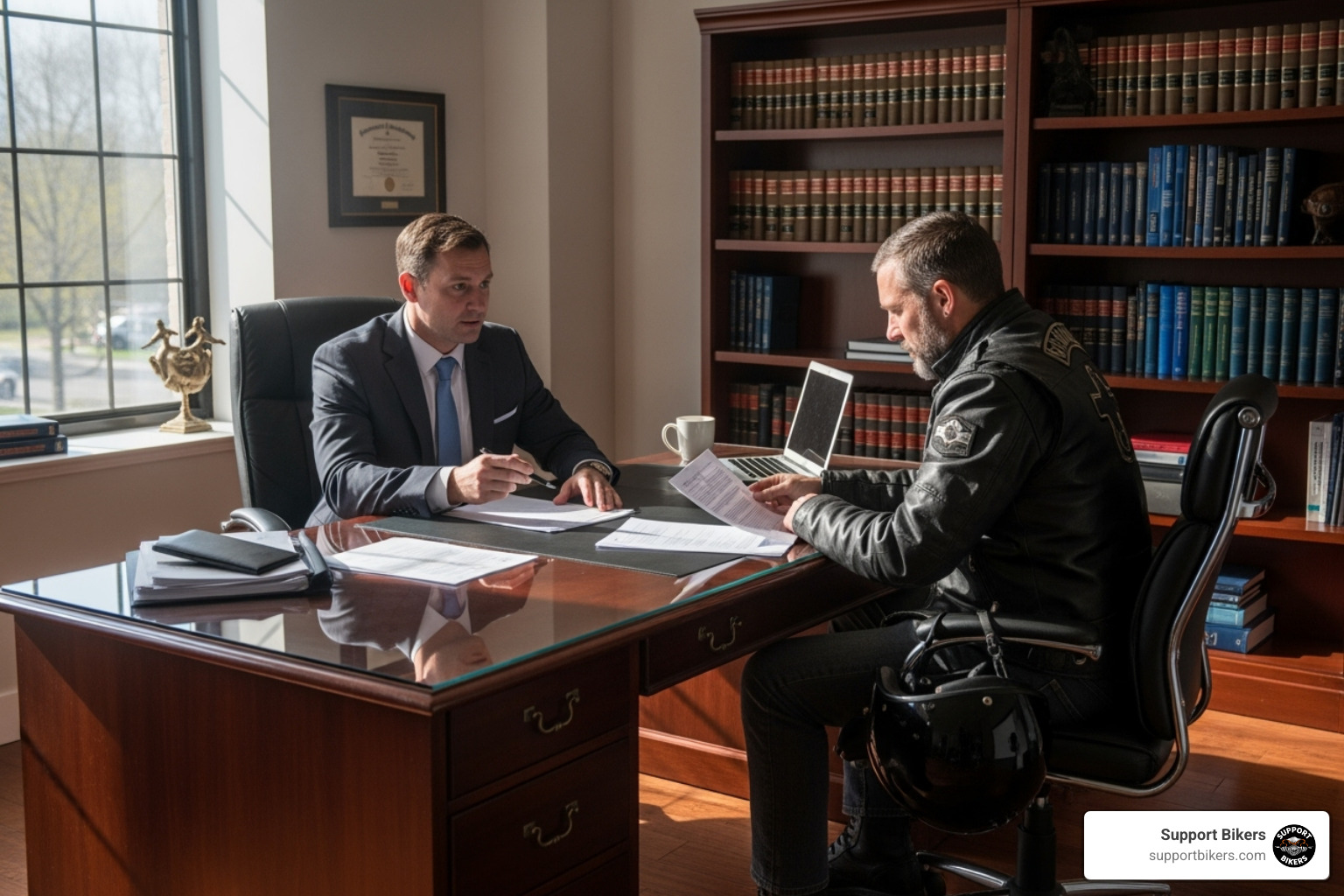
Navigating the motorcycle accident settlement process is complex, especially while recovering from injuries. This is why having a qualified, biker-focused lawyer is often the most critical step toward securing the compensation you deserve.
An experienced lawyer who understands the riding world knows how to counter the unfair biker bias that insurance adjusters and juries may hold against you. They are also experts in handling insurance company tactics, such as lowball offers, delay strategies, and attempts to shift blame. Your lawyer acts as a shield, managing all communications to protect you from being taken advantage of.
A lawyer’s primary role is to maximize your compensation. This goes beyond immediate bills to include future medical needs, lost earning capacity, and the significant pain and suffering you’ve endured. To do this, they must prove negligence by conducting a thorough investigation, gathering crucial evidence like police reports and witness statements, and building a compelling case that establishes fault.
Lawyers handle the complex legal process, from filing paperwork and meeting strict deadlines to navigating state-specific laws like comparative negligence. This frees you to focus on your recovery. Crucially, having legal representation provides significant leverage for settlement. Insurance companies are far more likely to offer a fair amount when they know you have a skilled attorney ready to take the case to trial if necessary. It sends a clear message that you are serious about receiving just compensation.
Motorcycle accident cases are complicated. A qualified lawyer can dramatically improve your chances of securing a fair settlement by navigating legal complexities and negotiating effectively on your behalf.
If you’ve been in a wreck and are weighing your options, we strongly encourage you to seek out professional legal help. You deserve someone who will fight for you. Find experienced Motorcycle Injury Lawyers in our curated directory.
Conclusion
So, we’ve ridden through the winding roads of the motorcycle accident settlement process together, haven’t we? It can feel like a tough journey after a crash, but understanding each turn empowers us, as riders, to steer it with confidence. We’ve covered everything from those crucial first moments at the scene to digging into the details of calculating damages and the often-tricky dance of negotiations. Every single detail truly matters when it comes to getting what you deserve.
What’s the big takeaway from all this? Well, if there’s one thing to remember, it’s that documentation is your best friend. Every medical record, every bill, every photo you snap, and every note you jot down builds a stronger foundation for your claim. Also, resist the urge to rush things. Quick settlements might sound appealing, but they almost always favor the insurance companies, not the injured rider. Give yourself the time needed for proper medical treatment and a thorough evaluation of all your losses. And finally, professional guidance is invaluable. Because of the unique challenges bikers face—from unfair societal biases to those aggressive insurance tactics—having a lawyer who truly “gets” the biker world is often the secret ingredient to getting the full and fair compensation you’re entitled to.
Here at Support Bikers, our mission is to empower riders just like you with the knowledge and connections you need. We truly hope this guide has shed some light on the motorcycle accident settlement process and helped you see a clear path forward. If you’ve found yourself in a wreck, financial assistance may be available through the Wrecked Rider Fund. We’re here for you.



0 Comments