
The Battery Decision Every Rider Needs to Get Right in 2026
Lithium ion vs Lead acid is the defining upgrade for the 2026 motorcycle season. The battery under your seat will dictate your cold starts, your charging efficiency on long hauls, and how much weight your bike carries through every curve in the years ahead.
Here’s a quick breakdown of how these technologies stack up for the 2026 rider:
| Factor | Lithium Ion | Lead Acid |
|---|---|---|
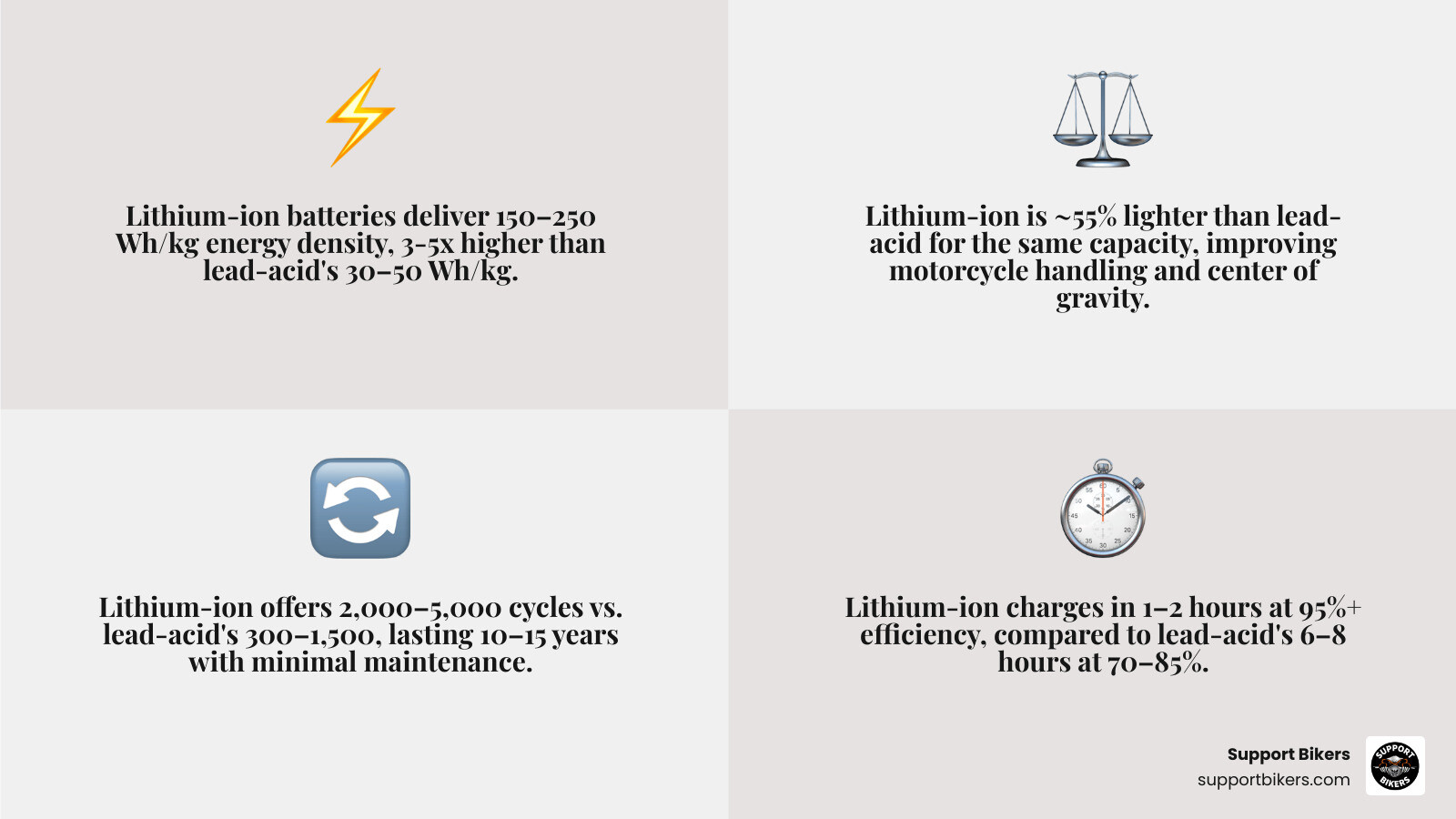
| Energy Density | 150–250 Wh/kg | 30–50 Wh/kg |
| Weight (same capacity) | ~55% lighter | Heavier baseline |
| Cycle Life | 2,000–5,000 cycles | 300–1,500 cycles |
| Depth of Discharge | 85–100% | ~50% |
| Charge Time | 1–2 hours | 6–8 hours |
| Efficiency | 95%+ | 70–85% |
| Upfront Cost | $100 – $250 | $75-$150 |
| Lifespan | 4-6 years | 1-3 years |
| Maintenance | Minimal | Regular upkeep needed |
Bottom line: For the 2026 season, Lithium ion wins on performance, weight, and long-term value. Lead acid remains a viable choice for specific cold-weather needs and upfront savings. The right choice depends on your future riding plans.
For most riders, this isn’t just a spec sheet argument. It’s a real-world question for your first cold morning start in Ohio, your third multi-day tour through the Smoky Mountains, or the moment you realize your old battery just won’t hold a charge anymore.
Battery technology has moved fast. What was “premium” a few years ago is now the standard expectation for serious riders heading into the 2026 season. I’m Sonny Da Badger, and while my experience wrenching on bikes dates back to my first dirtbike , my focus today is on the technology that will define our 2026 adventures. Let’s break it all down so you can make the right call for the future of your bike.
The 2026 Performance Standard: Lithium Ion vs Lead Acid
As we look toward the 2026 riding season, the performance gap between these two technologies has never been wider. When we talk about Lithium ion vs Lead acid, we are comparing a century-old chemistry with modern, high-density power.
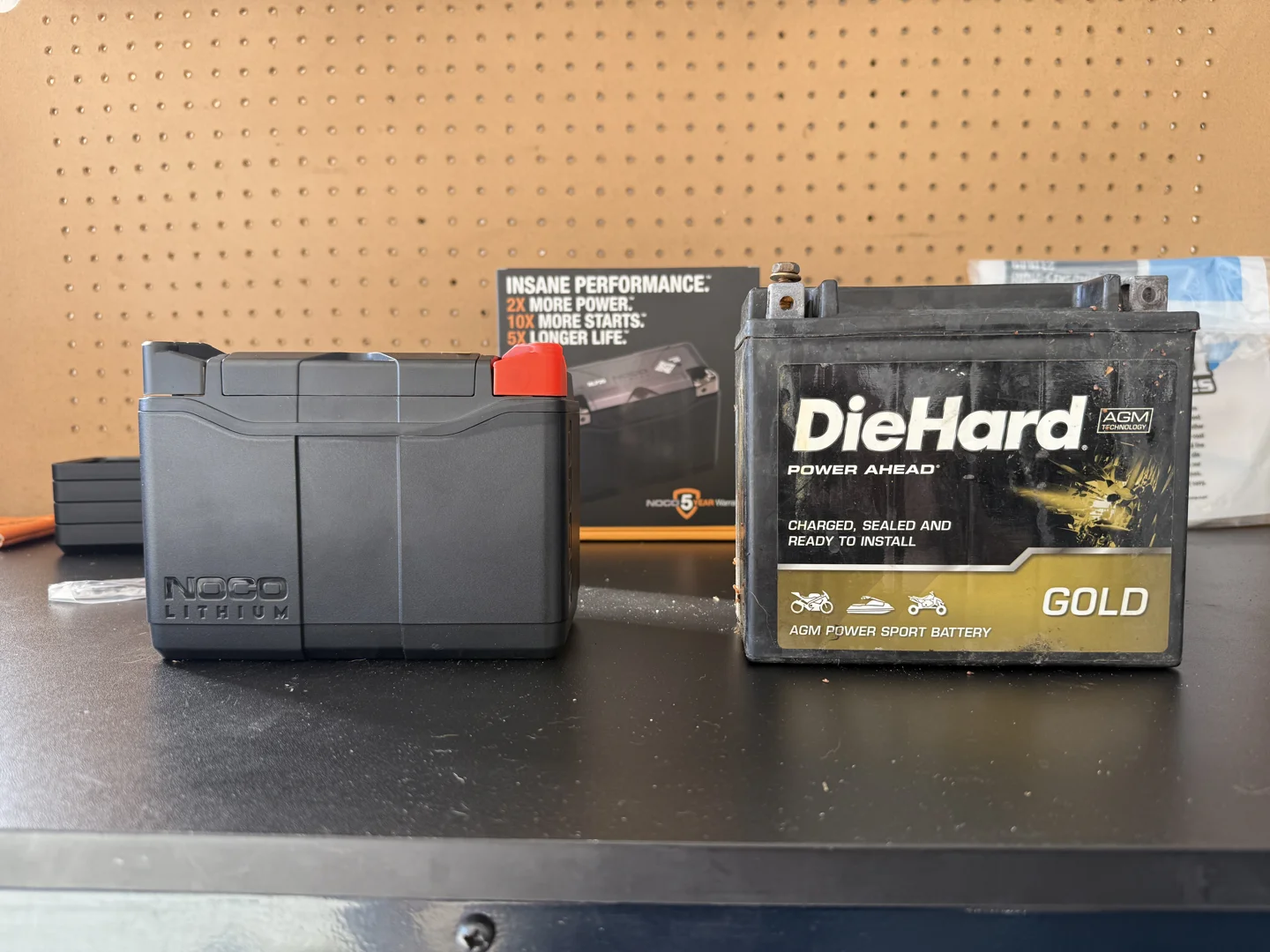
The most immediate difference we feel as riders is the weight. Lithium-ion batteries are, on average, 55% lighter than their lead-acid counterparts. If you are tossing a heavy cruiser through the Dragon’s Tail or navigating the tight bends in the Pennsylvania mountains, shedding 5 to 10 pounds from a high-mount battery box makes a noticeable difference in your center of gravity.
Energy Density and Efficiency
Energy density is where lithium truly shines. While lead-acid batteries hover around 30-50 Wh/kg, lithium-ion technology delivers a staggering 150-250 Wh/kg. This means you get five times the energy capacity in a package that is half the weight. Furthermore, lithium batteries operate at 95% efficiency or higher, meaning almost all the energy you put in during a charge is available to crank your engine. Lead-acid batteries often lose 15-30% of that energy to heat and internal resistance during the charging process.
To understand how this affects your bike’s ability to handle high-demand electronics, it is helpful to look at the C-rate and discharge performance. In 2026, with more bikes featuring heated seats, advanced GPS, and radar-assisted cruise control, having a battery that doesn’t “sag” under load is critical.
Cranking Power and Lithium Ion vs Lead Acid Efficiency
When you hit the starter button on a cold morning in Illinois or Nebraska, you need Cold Cranking Amps (CCA). Traditionally, lead-acid was the king of the “big hit” of power. However, 2026 lithium technology has bridged that gap. Lithium batteries provide a much flatter discharge curve, meaning they maintain a higher voltage for a longer period while cranking.
While lead-acid batteries start strong but fade quickly as the voltage drops, lithium stays “stiff,” providing consistent power until the battery is nearly depleted. This is a massive advantage for high-compression V-twins that need every bit of juice to turn over those massive pistons. To keep your starting system in top shape, don’t forget to check out our motorcycle yearly maintenance complete guide.
Depth of Discharge in Lithium Ion vs Lead Acid Systems
One of the biggest “gotchas” with lead-acid batteries is the 50% rule. If you consistently discharge a lead-acid battery past 50% of its capacity, you are effectively killing its lifespan through sulfation. Lithium-ion batteries, specifically the LiFePO4 (Lithium Iron Phosphate) variants common in motorcycles, can safely handle a Depth of Discharge (DoD) of 85% to 100% without damage.
This means that a 10Ah lithium battery actually provides more usable power than a 14Ah lead-acid battery. If you’re a rider who enjoys off-grid camping or infrequent battery use on long trips, lithium gives you a much larger safety net before you’re left stranded with a dead bike.
Long-Haul Value: Upfront Costs vs. Total Ownership

As we head into 2026, we’ve all been there — standing at the parts counter in a shop in Pennsylvania or Ohio, looking at the price tag of a lithium battery and wincing. There is no way around it: the upfront cost of lithium is higher. A high-quality lithium system can range from $100 – 300, though for a single motorcycle battery in the 2026 market, you’re looking at roughly 1.5x the price of a standard lead-acid unit.
However, we have to look at the Total Cost of Ownership (TCO) for your future riding seasons. A lead-acid battery typically lasts 1 to 3 years (or 300-1,500 cycles) if you treat it perfectly. In the real world, many riders replace them every 2 years. Lithium-ion batteries are rated for 2,000 to 5,000 cycles and can easily last 3 to 5 years.
If you plan on keeping your bike through the late 2020s, the lithium battery actually becomes the cheaper option. You would likely buy two lead-acid batteries in the time it takes to wear out one lithium unit. When you factor in the labor costs of finding the best motorcycle repair shops for replacements, the math starts to favor the “expensive” battery. For a deeper dive into these economics, check out the research on total cost of ownership.
Maintenance and Safety: The Role of the BMS
One of the best things about the Lithium ion vs Lead acid transition heading into 2026 is the death of “battery watering.” If you’ve ever had to top off the cells of an old-school lead-acid battery with distilled water, you know the hassle. Even “Maintenance Free” AGM (Absorbed Glass Mat) batteries require regular charging to prevent sulfation if the bike sits for more than a couple of weeks.
Lithium batteries are truly “set it and forget it” for the modern rider. They have a much lower self-discharge rate — about 5 times lower than lead-acid. You can leave a lithium battery in your bike for months, and it will likely fire right up for your first 2026 spring ride.
The Brain of the Battery: The BMS
The secret sauce in lithium batteries is the Battery Management System (BMS). Unlike lead-acid, which is just a “dumb” box of lead and acid, lithium batteries contain a circuit board that monitors:
- Voltage: Ensures cells stay balanced.
- Temperature: Prevents charging in extreme cold or discharging in extreme heat (thermal runaway).
- Overcharge Protection: Shuts down the circuit if your regulator/rectifier fails and tries to cook the battery.
This integrated safety makes lithium incredibly reliable for the future of motorcycling. If you’re doing your own wrenching in 2026, I always recommend having the right tools on hand. You can find the exact gear I use in Sonny’s Battery List on Amazon. Whether you’re at a shop in Fort Worth, Texas, or in your own garage in Louisiana, safety and the right tech go hand-in-hand.
Choosing Your Power: When to Stick with Lead Acid
Even with all the advantages of lithium, lead-acid still has a place in the 2026 market. If you are doing a vintage restoration where you want everything to look period-correct, or if you’re on a strict budget for a bike you plan to sell soon, lead-acid makes sense.
Lead-acid is also the “king of the cold.” While lithium discharges well in the cold, it cannot be charged if the internal temperature is below freezing (32°F). If you ride year-round in states like Nebraska or Kansas and your bike sits outside, a lithium battery might refuse to take a charge from the alternator until it warms up. Lead-acid batteries are much more forgiving of sub-zero charging.
Furthermore, lead-acid batteries are the most recycled consumer product in the world, with a 95%+ recycling rate. While lithium recycling is improving, it hasn’t yet reached the established infrastructure of lead. If you’re a fan of DIY motorcycle repairs and want a robust, familiar technology, there’s no shame in sticking with what works.
Frequently Asked Questions about Motorcycle Batteries
Can I swap my lead-acid battery for lithium-ion in 2026?
Yes, in almost all cases. Most modern lithium motorcycle batteries are designed as “drop-in replacements” with the same physical dimensions as standard lead-acid sizes. However, you must ensure your bike’s charging system is functioning correctly. A failing voltage regulator that “over-spikes” can trigger the lithium battery’s BMS to shut down for safety.
How do lithium batteries handle winter storage in states like Ohio or Pennsylvania?
Lithium batteries actually handle storage better than lead-acid because they don’t lose their charge as quickly. However, you should not leave them on a traditional “trickle charger” designed for lead-acid. You need a lithium-specific maintainer that doesn’t use a “desulfation mode,” which can damage lithium cells.
Is the fire risk higher with lithium-ion batteries on a bike?
This is a common myth. The batteries used in motorcycles are typically Lithium Iron Phosphate (LiFePO4), which is much more chemically stable than the Lithium Polymer (LiPo) batteries found in cell phones or laptops. With a built-in BMS, the risk of a “thermal event” is extremely low — often lower than the risk of a lead-acid battery leaking acid and eating through your bike’s frame.
Conclusion
Choosing between Lithium ion vs Lead acid for your 2026 travels comes down to your priorities. If you want the lightest, fastest-charging, and longest-lasting power for your future adventures, lithium is the clear winner. If you’re riding a budget-friendly commuter or frequently brave the freezing winters of the Midwest, lead-acid still offers reliable service.
At Support Bikers, we’re here to make sure you have the resources you need to stay on the road. If you or someone you know has been through a rough patch, remember the Support Bikers community. It’s a place for riders to find support and connection after an accident. Join us at the Support Bikers Facebook Group.
Stay safe, keep the shiny side up, and we’ll see you out there for the 2026 riding season! To help us support the community, please consider a donation to the Support the Wrecked Rider Fund.




0 Comments