Indian vs Harley: 2025’s Ultimate Battle
An All-American Rivalry Reborn
The Indian vs Harley debate represents America’s most legendary motorcycle rivalry. Here’s what you need to know:
Quick Comparison:
- Indian Motorcycle: Founded 1901, liquid-cooled engines, modern tech focus, owned by Polaris
- Harley-Davidson: Founded 1903, air-cooled tradition, classic styling, independent company
- Best for Touring: Indian Pursuit Dark Horse (more power, cooler running)
- Best for Performance Cruising: Harley Low Rider S (better handling, more aftermarket support)
- Price Range: Harley generally starts lower, Indian offers more standard features
This rivalry began over 120 years ago when Indian Motorcycle Company started production in 1901, followed by Harley-Davidson in 1903. Both brands served American troops in World War I and battled for market dominance through the early decades of motorcycling.
Indian faced decades of decline and ownership changes before Polaris Industries revived the brand in 2011. Today, the competition burns hotter than ever, with both manufacturers offering everything from stripped-down bobbers to luxury touring machines.
Modern battlegrounds include:
- Full-dress touring bikes for cross-country adventures
- West Coast-style performance cruisers
- Technology integration and rider aids
- Build quality and reliability
- Dealer networks and aftermarket support
I’m Sonny Da Badger, and I’ve experienced the Indian vs Harley rivalry during my time selling Harleys at Six Bends Harley Davidson and through owning multiple bikes from different manufacturers but have not owned an Indian yet. This guide will help you decide which American icon deserves a spot in your garage.
If you’re a rider who has been in an accident, you may be eligible for financial assistance. Learn more about the Wrecked Rider Fund.

The Heavyweight Title: Full-Dress Touring Showdown
Picture yourself on an endless ribbon of asphalt, your bike loaded for weeks on the road. That’s the magic of full-dress touring motorcycles—rolling living rooms built to devour miles in comfort for you and a passenger.
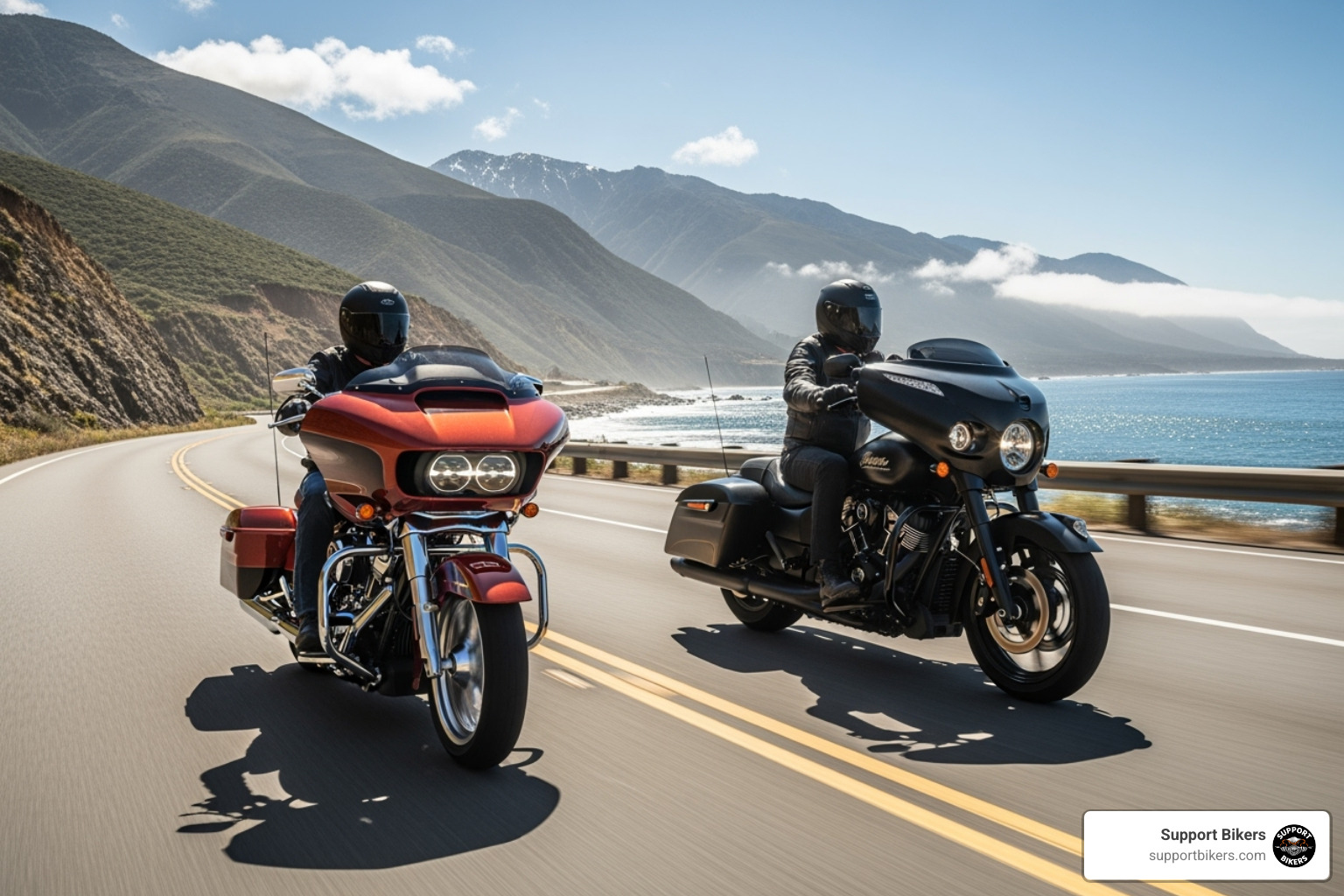
In the Indian vs Harley touring world, two machines stand out: the Harley-Davidson Road Glide Limited and the Indian Pursuit Dark Horse. They’re your ticket to cross-country adventures, with ample storage and all the creature comforts you could want.
Both bikes promise that classic American touring experience, but they deliver it in surprisingly different ways. Let’s dig into what makes each one special and which might be the better companion for your next epic road trip.
Engine Philosophy: Air-Cooled Tradition vs. Liquid-Cooled Power
The heart of any great touring bike is its engine, and here’s where the Indian vs Harley story gets really interesting. These two manufacturers took completely different paths to touring greatness.
Harley’s Road Glide Limited runs the legendary Milwaukee-Eight 114 engine. This air-cooled V-twin pumps out 93 horsepower and 122 lb-ft of torque from its 114 cubic inches. For Harley purists, those exposed cooling fins aren’t just functional – they’re part of the soul of the machine. There’s something deeply satisfying about that raw, traditional approach.
But here’s the catch: that air-cooled engine gets hot. I’m talking legitimately uncomfortable on warm days, especially in stop-and-go traffic. Harley tries to help with their Engine Idle Temperature Management System (EITMS), which shuts down the rear cylinder at idle. Even so, you’ll feel like you’re sitting on a space heater during summer rides through Phoenix or Vegas.
The Indian Pursuit Dark Horse takes a completely different approach with its PowerPlus Liquid-Cooled 108 engine. This modern powerhouse cranks out 122 horsepower and 128 lb-ft of torque – that’s a whopping 29 more horses than the Harley. More importantly, it runs dramatically cooler thanks to liquid cooling.
The difference is night and day. Where the Harley might have you sweating through your gear, the Indian keeps its cool even in brutal heat. For long-distance touring, especially in warmer climates, this isn’t just about comfort – it’s about arriving at your destination refreshed instead of roasted.
On the Road: Specs, Comfort, and Features
When you’re comparing touring bikes, the devil is in the details. Let’s break down how these two heavyweights stack up where it really matters:
| Feature | Harley-Davidson Road Glide Limited | Indian Pursuit Dark Horse |
|---|---|---|
| Starting Price | $28,729 | $30,999 |
| Wet Weight | 932 pounds | 912 pounds |
| Storage | 4.7 cubic feet | 5.6 cubic feet |
| Fuel Capacity | 6 gallons | 6 gallons |
| Claimed MPG | 43 mpg | 34-37 mpg |
| Range | 258 miles | 204-222 miles |
| Front Brakes | Dual 300 mm discs | Dual 320 mm discs |
| Rear Brakes | Single 300 mm disc | Single 298 mm disc |
The Indian gives you more storage space for your gear and 20 fewer pounds to haul around. That extra storage might not sound like much, but when you’re packing for a two-week trip, every cubic foot counts.
The Harley fights back with superior fuel economy. Those extra miles per gallon add up to about 50 more miles between gas stops. On long interstate stretches through the middle of nowhere, that range advantage is genuinely valuable.
Both bikes handle beautifully for their size, but in different ways. The Indian feels more athletic – it’s eager to lean into corners and responds quickly to steering inputs. The Harley prioritizes stability over sportiness, with a planted, confidence-inspiring feel that’s perfect for highway cruising.
The comfort equation is more complex than you might think. Both bikes offer excellent wind protection and relaxed riding positions. The Indian’s electronically adjustable windshield is a nice touch, though it limits your aftermarket options. Harley’s frame-mounted fairing is a touring classic that’s been refined over decades.
For infotainment, you get two solid systems with different strengths. Indian’s Ride Command features a large touchscreen that’s intuitive to learn, with built-in GPS and the ability to lock your saddlebags remotely. Harley’s Boom! Box system lets you control everything through handlebar switches, meaning less reaching for the screen while riding.
Both manufacturers include modern rider aids like lean-sensitive traction control and ABS. These systems adjust their intervention based on how far you’re leaned over, giving you confidence in various road conditions.
The Verdict for the Long Haul
After thousands of miles on both machines, the Indian Pursuit Dark Horse takes the crown for serious cross-country touring. The combination of extra power, cooler running engine, and more storage space creates a more comfortable and capable touring experience.
That liquid cooling makes a huge difference on long rides. You arrive at your destination feeling fresh instead of overheated. The extra horsepower gives you confidence when passing slower traffic or climbing mountain grades with a loaded bike.
The Harley Road Glide Limited remains an excellent choice, especially if you prioritize fuel range and that classic air-cooled V-twin character. Its superior efficiency means fewer fuel stops, and there’s something special about that traditional Harley experience that keeps riders coming back.
Beyond the Indian vs Harley debate, other excellent touring options exist. The Honda Goldwing offers best smoothness and technology starting around $25,300. The BMW K1600 GT brings sport-touring performance with 160 horsepower, priced between $24,690 and $28,540.
Both American bikes deliver that special touring experience you can’t get from anything else. The choice comes down to whether you value modern performance and comfort or traditional character and range.
If you’re a rider who has been in an accident, you may be eligible for financial assistance. Learn more about the Wrecked Rider Fund.
The West Coast Clash: The Indian vs Harley Performance Cruiser Duel
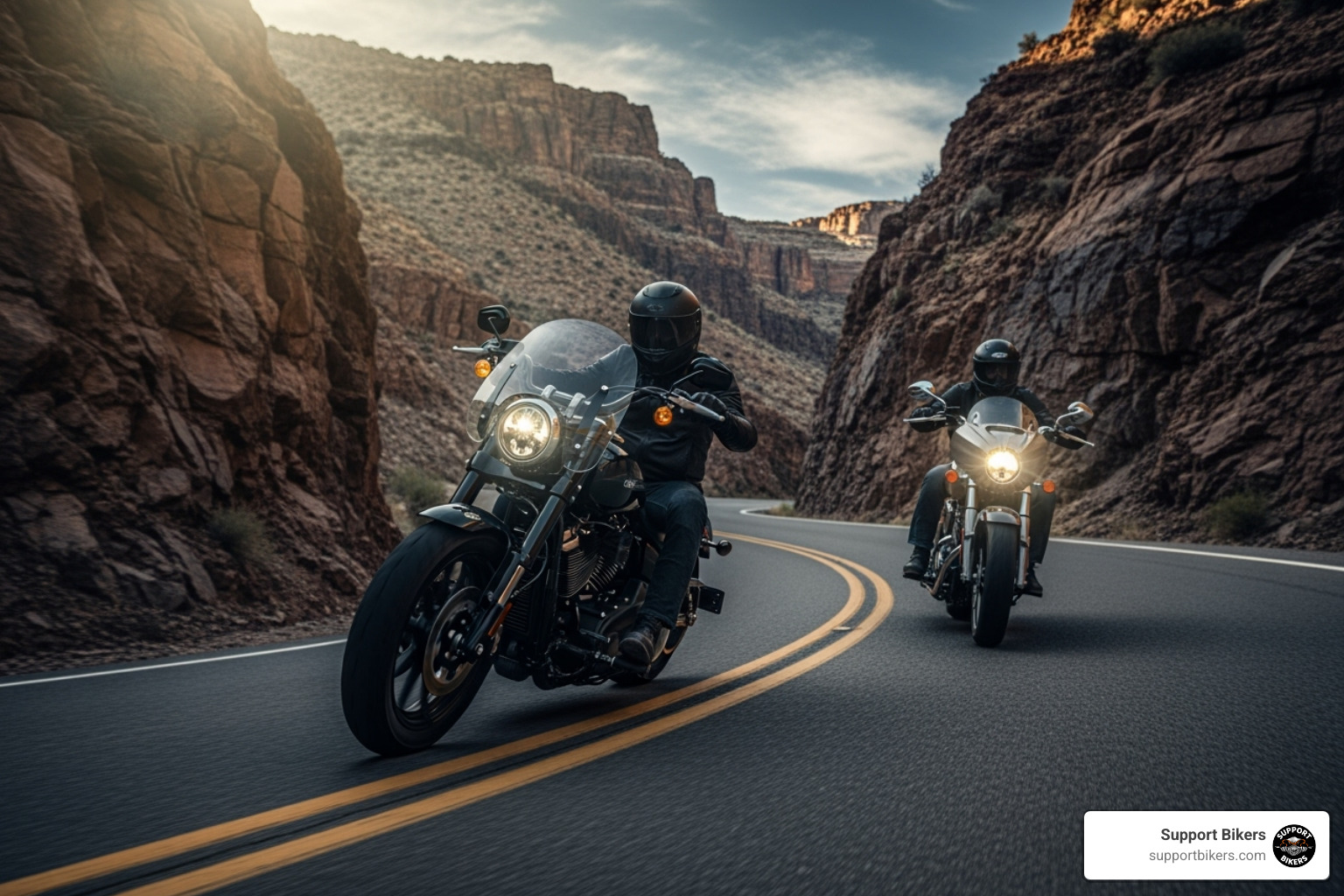
When you want to feel the raw power of American iron beneath you, performance cruisers deliver that heart-pounding experience like nothing else. This is where the Indian vs Harley rivalry gets serious about speed, handling, and pure riding excitement. We’re talking about bikes that embody the West Coast club style – think aggressive stance, serious power, and the kind of presence that turns heads at every stoplight.
For this showdown, we’re putting the Harley-Davidson Low Rider S head-to-head with the Indian Sport Chief. These aren’t your typical laid-back cruisers. They’re built for riders who want to carve canyon roads, dominate city streets, and experience every ounce of performance their engines can deliver.
The West Coast style runs deep in motorcycle culture, with its signature T-bars, quarter fairings, and upgraded suspension. Harley’s FX models pioneered this look decades ago, and the Low Rider S carries that torch with modern engineering. Indian jumped into this arena with their 2022 Chief platform redesign, creating the Sport Chief to challenge Harley’s dominance in this space.
Performance and Power
Here’s where things get interesting in the Indian vs Harley performance battle. Power numbers tell a compelling story, but real-world riding experience reveals the whole truth.
The Harley-Davidson Low Rider S packs the Milwaukee-Eight 117 engine, and this beast doesn’t mess around. On the dyno, it cranks out 92.98 horsepower and 114.82 lb-ft of torque at the rear wheel. That’s serious power that you can feel every time you twist the throttle. The engine’s character is what really sets it apart – it delivers smooth, flexible power that responds instantly whether you’re launching from a red light or passing slower traffic on the highway.
When we put it to the test, the Low Rider S blazed through the quarter-mile in 12.34 seconds at 110.07 mph. That’s legitimate performance that puts many sport bikes on notice.
The Indian Sport Chief brings its Thunderstroke 116 engine to the fight, producing 73.70 horsepower and 105.17 lb-ft of torque. While those numbers look respectable on paper, the reality is more complex. The Sport Chief’s power delivery feels more peaky – you need to work the engine harder to access its full potential. Its quarter-mile time of 13.33 seconds at 102.64 mph shows it’s no slouch, but it’s clearly playing catch-up to the Harley.
In everyday riding, that power difference becomes obvious. The Low Rider S feels eager and responsive at any rpm, giving you instant thrust when you need it. The Sport Chief requires more patience and planning, especially when you need quick acceleration for highway merging or spirited canyon runs.
Handling, Braking, and Rider Experience
Raw power only tells part of the performance story. How these bikes handle, stop, and treat their riders makes the real difference between a good ride and a great one.
Braking performance reveals an interesting twist in this comparison. The Indian Sport Chief comes with fancy radially mounted Brembo calipers – the kind of hardware that looks impressive on spec sheets. But the Harley-Davidson Low Rider S delivers better real-world braking feel and control. The Harley’s system gives you more confidence when you’re braking hard, with better feedback through the lever that lets you modulate stopping power precisely.
Suspension and handling separate these bikes even further. The Low Rider S features inverted front forks and a monoshock rear, while the Sport Chief runs 43mm KYB inverted forks up front and Fox piggyback shocks in the rear. On paper, both sound capable. On the road, the Low Rider S handles like a much more agile machine.
At 678 pounds, the Harley is slightly lighter than the 687-pound Sport Chief, and you feel that difference when changing direction quickly. The Low Rider S transitions from side to side more willingly, making it more fun in twisty roads. More importantly, it offers 31.3 degrees of cornering clearance compared to the Sport Chief’s 29.5 degrees. That extra clearance means you can lean harder before scraping footpegs – a real advantage for aggressive riders. For more details on how suspension affects handling, check out this resource on motorcycle suspension.
Rider comfort presents trade-offs on both bikes. The Sport Chief sits lower at 27.0 inches compared to the Low Rider S’s 28.2-inch seat height, making it more accessible for shorter riders. The Indian’s seat foam is also more supportive for longer rides. However, the Low Rider S’s soft seat can create pressure points after an hour or two – though an aftermarket seat easily fixes this common complaint.
Electronics and refinement tip the scales toward Harley. While the Sport Chief offers a touchscreen display and multiple ride modes (Tour, Standard, Sport), our research shows it suffers from reliability issues. The display starts slowly, Sport mode feels overly aggressive, and some riders report starting problems that create “more headaches than other parts of the bike.”
The Low Rider S keeps things simpler but more reliable. It focuses on delivering a smooth, refined riding experience without the electronic glitches that can frustrate riders.
For a showroom-stock West Coast-style performance cruiser, the Harley-Davidson Low Rider S wins this battle. Its superior engine performance, better braking feel, more confident handling, and overall refinement make it the better choice for riders who want maximum performance and engagement right off the dealer floor. While the Sport Chief offers some nice features, the Low Rider S delivers where it matters most – in the pure joy of riding hard.
If you’re a rider who has been in an accident, you may be eligible for financial assistance. Learn more about the Wrecked Rider Fund.
The Culture and Community: Beyond the Motorcycle
When you buy a motorcycle, you’re not just purchasing a machine – you’re joining a family. The Indian vs Harley rivalry runs deeper than specs sheets and dyno numbers. It’s woven into the fabric of American motorcycle culture, where brand loyalty becomes part of your identity and weekend rides turn into lifelong friendships.
Walk into any Harley-Davidson dealership on a Saturday morning, and you’ll witness something special. Riders gather around gleaming bikes, sharing stories of cross-country adventures and weekend canyon runs. The Harley community has had over a century to develop this culture, creating an almost tribal bond among riders. Some folks complain about pushy salespeople or an “elitist” attitude at certain dealerships, but for millions of riders, that local Harley shop represents home base – a place where your passion is understood and celebrated.
Indian riders bring a different energy to the table. Since Polaris breathed new life into the brand in 2011, Indian’s community has grown rapidly, attracting riders who appreciate the underdog story. These are folks who love the heritage but want something that stands apart from the Harley crowd. Indian owners often describe feeling like part of an exclusive club – one that’s growing fast but still small enough that you wave at every other Indian you pass on the road.
The dealership experiences reflect each brand’s personality. Harley shops feel like established institutions, complete with leather jackets, branded coffee mugs, and walls covered in rally photos. Indian dealerships often have a more modern, approachable vibe, with staff eager to share the brand’s comeback story and highlight the latest technology features.

The Indian vs Harley Customization Scene
Here’s where the Indian vs Harley culture really comes alive – in the garage, with wrenches in hand and dreams of the perfect custom build. For both brands, making your bike uniquely yours isn’t just encouraged, it’s practically mandatory.
Harley-Davidson dominates the aftermarket world like no other motorcycle manufacturer. Decades of consistent production and millions of bikes on the road have created an ecosystem that’s simply staggering. Need a chrome air cleaner? You’ve got fifty options. Want to swap out your exhaust? Hundreds of choices await. This vast aftermarket support stems from Harley’s open design philosophy – most components are easily accessible, encouraging owners to tinker and personalize.
The joy of Harley ownership often extends far beyond riding. Many owners spend winter months in their garages, planning the next modification or restoration project. It’s therapy with a wrench, where every bolt turned brings you closer to your vision of the perfect bike.
Indian’s customization scene is exploding thanks to Polaris’s backing and the brand’s growing popularity. While you won’t find quite as many options as Harley offers, the aftermarket support improves dramatically each year. Performance shops are developing new parts for models like the Sport Chief and Challenger, and custom builders are showcasing increasingly creative Indian builds at shows nationwide.
The electronic windshield on many Indian models does limit some aftermarket choices compared to Harley’s traditional setups, but clever manufacturers are finding solutions. What Indian lacks in sheer volume of parts, it makes up for with innovation – many aftermarket companies see Indian as a fresh canvas for creative solutions.
Customization profoundly influences ownership experience for both brands. It transforms your relationship with the motorcycle from simple transportation to personal expression. Whether you’re installing Harley’s latest Screamin’ Eagle upgrade or adding Indian’s Thunder Stroke performance kit, you’re not just modifying a bike – you’re crafting your riding identity and connecting with a community of builders who share your passion.
If you’re a rider who has been in an accident, you may be eligible for financial assistance. Learn more about the Wrecked Rider Fund.
Frequently Asked Questions about Indian vs Harley
When riders are weighing their options in the Indian vs Harley debate, we hear the same questions come up time and again. Let me share some straight answers based on real-world experience and what we’re seeing in the community.
Which is more reliable, Indian or Harley?
This question always gets riders fired up, and honestly, it’s not as black and white as people want it to be. Both modern Indian vs Harley motorcycles are generally solid machines when you keep up with maintenance, but the devil’s in the details.
Harley-Davidson has the advantage of decades of continuous production. Walk through any motorcycle gathering, and you’ll see plenty of older Harleys still running strong. I’ve met riders with over 100,000 miles on their bikes, and some have pushed well beyond that mark. One rider I know put 136,000 miles on his 2001 Screamin’ Eagle Road Glide with only routine maintenance and minor repairs.
Indian’s modern story is different. Since Polaris brought the brand back in 2011, there have been some growing pains. Early models had their share of teething problems – that’s pretty normal when you’re essentially rebuilding a brand from scratch. I’ve heard stories of ECU failures and extended dealer visits that would frustrate any rider.
But here’s the thing: I’ve also met Indian owners who’ve racked up serious miles without major issues. One rider has 85,000 miles on his Indian bagger with just a clutch cable replacement. Another has put 37,000 trouble-free miles on his 2012 model.
The reality is that reliability often comes down to the individual bike, how it’s maintained, and sometimes just luck of the draw. Both brands have improved their manufacturing quality significantly in recent years. Your best bet is to research specific model years and check owner forums for common issues before making your decision.
Which brand holds its value better?
Harley-Davidson has traditionally been the king of resale value, and there are solid reasons for that. The brand recognition is massive, demand for used Harleys stays strong, and the aftermarket support means even older bikes can be kept running and customized. When someone sees a Harley for sale, they know what they’re looking at.
Indian’s resale story is still being written, but it’s getting better every year. As more riders find the brand and the dealer network expands, demand for used Indians is climbing. The combination of classic styling with modern technology appeals to a lot of buyers who want something different from the Harley crowd.
While Indian hasn’t reached Harley’s legendary resale heights yet, the gap is closing. If you’re buying an Indian today, you’re likely to see better resale value than Indian owners experienced just five years ago. The trend is definitely moving in the right direction.
Is Indian really an older company than Harley-Davidson?
Yes, Indian Motorcycle Company started production in 1901, beating Harley-Davidson to market by two years. Indian fans love to point this out, and they’re absolutely right about the timeline.
But here’s where it gets complicated. While Indian has the earlier founding date, the company’s history looks like a roller coaster. The original Indian Motorcycle Manufacturing Company shut down in 1953. After that, the brand bounced between different owners and had several stops and starts before Polaris successfully revived it in 2011.
Harley-Davidson, founded in 1903, has maintained continuous production for over 120 years. They had their own challenges, including the AMF ownership period that many riders prefer to forget, but the bikes never stopped rolling off the production line.
So while Indian wins the “who was first” debate, Harley-Davidson claims the prize for staying power. Both facts matter, depending on how you look at motorcycle history. What really counts is that both brands are here today, building great bikes and keeping this legendary American rivalry alive.
If you’re a rider who has been in an accident, you may be eligible for financial assistance. Learn more about the Wrecked Rider Fund.
The Final Verdict: Which American Icon is Right for You?
After riding both brands extensively and diving deep into the Indian vs Harley rivalry, one thing becomes crystal clear: there’s no universal “winner” here. Both American icons excel in different ways, and your perfect choice depends entirely on what makes your heart race and your riding soul sing.
For the long-distance cruiser, our testing revealed that the Indian Pursuit Dark Horse takes the crown. That liquid-cooled PowerPlus engine isn’t just about the extra 29 horsepower – though that certainly doesn’t hurt when you’re passing a slow-moving RV on a two-lane highway. It’s about comfort on those scorching summer days when you’re stuck in traffic outside Phoenix, and your bike isn’t turning into a furnace beneath you. The cooler operation, combined with more storage space and modern tech, makes those cross-country adventures more enjoyable.
But don’t count out the Harley-Davidson Road Glide Limited just yet. If you’re someone who values that classic air-cooled rumble, appreciates the vast aftermarket ecosystem, and prioritizes fuel range over raw power, the Road Glide remains an exceptional touring companion. Plus, there’s something to be said for pulling into a gas station and having fellow riders instantly recognize that distinctive Harley silhouette.
In the performance cruiser arena, the Harley-Davidson Low Rider S dominated our testing. With its Milwaukee-Eight 117 engine delivering superior power and that flexible torque curve, it simply outperformed the Indian Sport Chief in nearly every metric that matters for spirited riding. The better handling, more cornering clearance, and confident braking make it the clear choice for riders who want West Coast style with serious performance to back it up.
The beauty of this rivalry lies in the fact that both manufacturers are pushing each other to build better motorcycles. Indian’s modern approach forces Harley to innovate, while Harley’s heritage and community keep Indian striving to prove itself worthy of America’s motorcycle legacy.
Your decision ultimately comes down to philosophy: Do you lean toward modern performance and technology, or do you cherish tradition and heritage? Are you drawn to liquid-cooled efficiency, or does the character of an air-cooled V-twin speak to your soul? Do you want the established aftermarket support of Harley, or are you excited to be part of Indian’s growing renaissance?
Here’s our strongest recommendation: take both for a test ride. Feel how each engine responds to your right hand. Experience the differences in handling, comfort, and character. Listen to your gut reaction when you fire up each bike for the first time. The specs and reviews can guide you, but only you can determine which American icon deserves a place in your garage.
The best motorcycle is the one that gets you out riding more often. Whether you choose the heritage and tradition of Harley-Davidson or the modern performance of Indian Motorcycle, you’ll be joining a passionate community of riders who understand that life is better on two wheels.
If you’re a rider who has been in an accident, you may be eligible for financial assistance. Learn more about the Wrecked Rider Fund.

0 Comments