5 Pennsylvania Motorcycle Laws You Should Know
As you may know, there are a few motorcycle laws that vary from state to state.
This can cause some confusion when traveling across state lines on longer trips. Here,
you’ll find some of the bike laws specific to Pennsylvania. Whether you’re just passing
through or you call the Keystone State home, these are 5 laws you should be aware of
when riding in PA.
1. Lane Splitting and Lane Filtering
Lane splitting is when a rider weaves through occupied lanes of moving
traffic, sometimes also referred to as “white lining” or “stripe riding”. It is
sometimes confused with lane filtering, which is when a rider weaves through
stopped traffic, like in the case of an accident or construction. Some states have
different laws for each of these riding practices, but they are both outlawed in
most of the US, including Pennsylvania. California is the only state to officially
allow lane splitting, and other states vary on enforcement.
Lane splitting and lane filtering are illegal in Pennsylvania for safety
reasons due to the increased risks that come with riding in between traffic. When
riding between lanes, you may be less visible to other vehicles. You may also
encounter hazards like protruding side mirrors and unexpected lane changes, and
have less space to maneuver around any obstacles in the road. When sharing the
road with automobiles, it is safest to stay in your own lane. There, you are most
visible and have the most time to stop or swerve in case of any hazards.
2. Riding Together
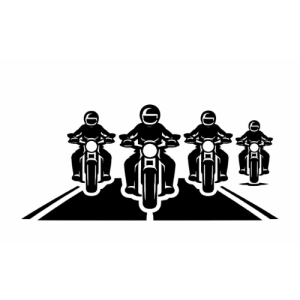
In Pennsylvania, it is illegal to ride with more than two motorcyclists next
to each other in a single lane. Generally, it is not recommended to ride two
abreast, even though it is technically legal. Sharing the lane means you have less
space to maneuver around any obstacles or road hazards. If riding in a group, a
staggered formation is most recommended to give everyone space to operate
safely. One rider takes the left side of the lane and leaves the right side empty, the
next takes the right and leaves the left empty, and so on. This gives each rider the
most space to stop and swerve as needed, while keeping the group together as
one.
Riding in a very large group is not recommended. If your large group must
ride together, designate smaller groups to prevent separation at traffic lights and
leaving anyone behind. Keep your least experienced riders up front to look out for
their safety, let them set the pace, and keep them from being left behind.
3. Pennsylvania’s “Ride on Red” Law
We all know the sensor technology used in traffic lights is far from perfect.
You’ve probably experienced the frustration and confusion of sitting at a red light
and waiting for it to turn for what feels like forever. What’s happening here is that
the sensor technology isn’t picking up on your bike, so it doesn’t register the need
to change the light. Pennsylvania’s “Ride on Red” law took effect in 2016, making
sure no biker is left stuck at a red light all day again.
The law states that in the event of a stop light malfunction, such as failing
to recognize your vehicle, the light may be treated as a stop sign and you may
proceed with caution. It is important to note that this does NOT mean that any
functioning stop light may be treated as a stop sign. The light must not be
working for this law to protect you.
4. Pennsylvania Helmet Laws
In Pennsylvania, all riders and passengers of a motorcycle are required by
law to wear protective headgear, but there are a few exceptions to this rule.
Riders who are over the age of 21 AND who have been riding for two full calendar
years, or have taken a PennDOT approved safety course are not required to wear
a helmet. If a rider meets this requirement, their passengers are not required to
wear a helmet either if they are over the age of 21. However, protective headgear
is always recommended for your safest ride. Head injuries are the cause of death
in over 50% of motorcycle accidents and helmets are proven to be effective in
reducing these injuries.
5. Protective Eyewear Requirement
Pennsylvania law requires all riders to wear protective eye gear. Unlike the
helmet law, there are no exceptions to this rule. Every motorcyclist must wear
adequate eye protection. Plastic, shatter-resistant face shields can help protect
your face in a crash, and make your ride more comfortable (no bugs in the
teeth!). Any type of protective eyewear is acceptable by law, but
shatter-resistance is an important safety feature that is always recommended. In
the event of a crash, shatter-resistant eyewear can protect your eyes from
damage, but shattering eye gear can become a safety hazard in itself.
Make sure to obey all of these laws when traveling throughout
Pennsylvania and do your research on the specific laws of any other states you
plan on visiting. Should you encounter any legal trouble (on the road or off!), feel
free to contact us at O’Connor Law.
We are here for the biker community! Enjoy the ride and stay safe!
https://www.oconnorlaw.com/
800-518-4529


0 Comments